Regular Expression Denial of Service Prevention Checklist
Catastrophic backtracking in regular expressions turns pattern matching into an exponential resource drain that exposes services to denial of service attacks.

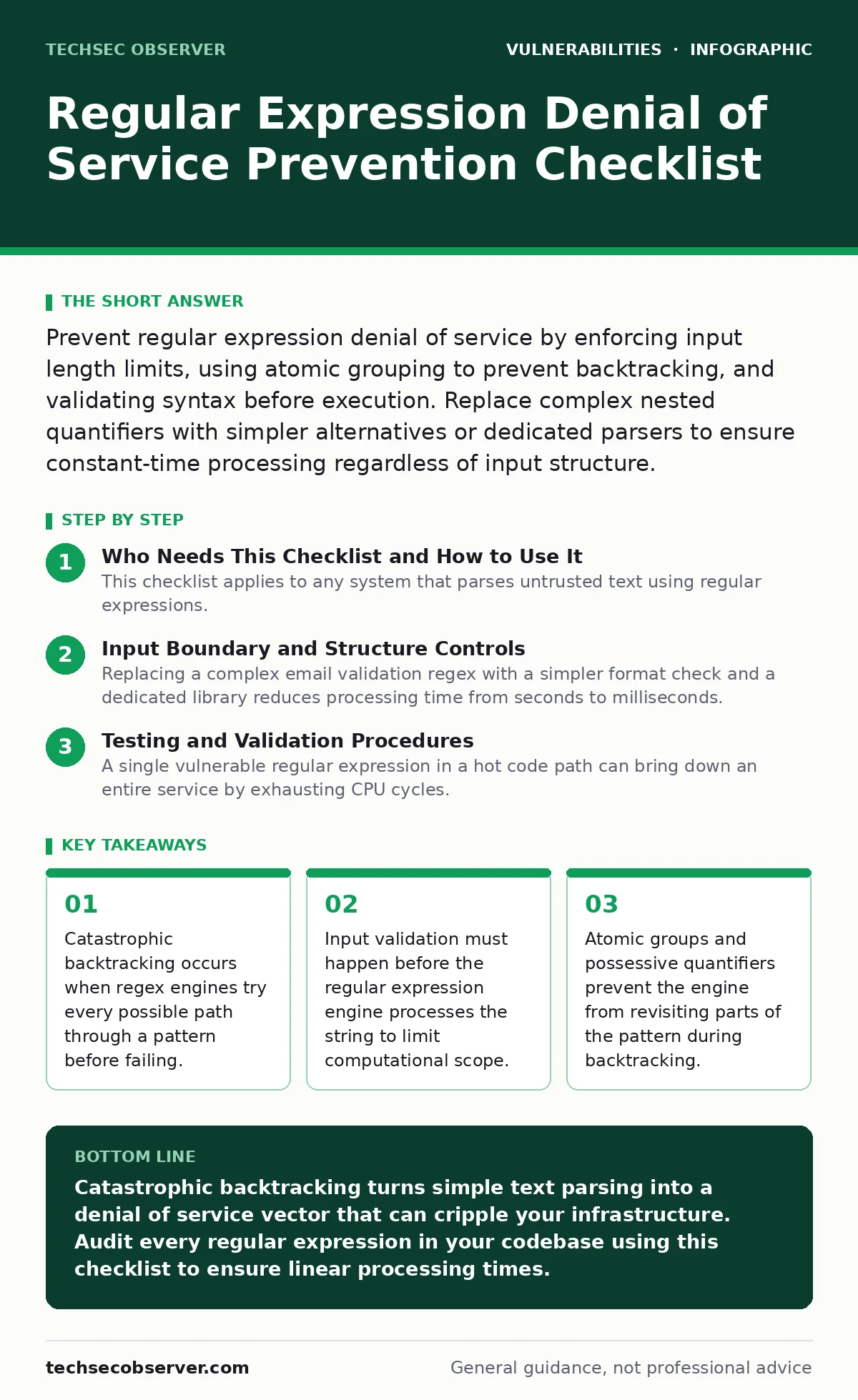
Prevent regular expression denial of service by enforcing input length limits, using atomic grouping to prevent backtracking, and validating syntax before execution. Replace complex nested quantifiers with simpler alternatives or dedicated parsers to ensure constant-time processing regardless of input structure.
Who Needs This Checklist and How to Use It
This checklist applies to any system that parses untrusted text using regular expressions. You use it during code review and before deploying new parsing logic. Each item requires a specific code change or configuration adjustment. Treat this list as a mandatory gate for any feature handling user-supplied strings.
Input Boundary and Structure Controls
- Enforce strict maximum length on all inputs: Limiting character count prevents attackers from constructing inputs that trigger exponential processing times.
- Validate input format before regex execution: A simple whitelist check ensures the string matches expected structures before expensive parsing begins.
- Reject binary or control characters early: Non-printable characters often indicate malformed data that bypasses logical flow assumptions in pattern matching.
- Use character classes instead of dot-matches: Specific character sets reduce the search space and prevent unintended matches that increase backtracking.
Pattern Design and Quantifier Safety
- Avoid nested quantifiers on overlapping sets: Patterns like
(a+)+create ambiguity where the engine tests multiple ways to divide the input among groups. - Replace greedy quantifiers with possessive variants: Possessive quantifiers consume input without giving it back, eliminating the backtracking that causes denial of service.
- Use atomic grouping for complex sub-patterns: Atomic groups tell the engine to keep the matched portion permanently, preventing re-evaluation of that section.
- Prefer explicit anchors over implicit ones: Anchoring patterns to the start and end of the string ensures the engine does not scan irrelevant parts of the input.
Engine Selection and Configuration
- Choose an engine that supports possessive quantifiers: Not all regular expression engines offer these features, so selecting the right library is a primary defence.
- Set a timeout for regex operations: If a pattern takes too long, aborting the process prevents the thread from being tied up indefinitely.
- Disable backtracking in the engine if possible: Some engines allow configuration options that restrict backtracking depth, providing a safety net for complex patterns.
- Use non-backtracking engines for critical paths: Engines like RE2 guarantee linear time complexity by design, removing the risk of catastrophic backtracking entirely.
Testing and Validation Procedures
- Test with crafted worst-case inputs: Generate strings that maximise ambiguity in your pattern to verify that processing time remains constant.
- Measure execution time against input length: Plotting time versus length reveals exponential growth curves that indicate vulnerability to regular expression denial of service.
- Include regex safety in secure code review: Reviewers should specifically look for nested quantifiers and unbounded repetitions in every pull request.
- Monitor server CPU spikes during parsing: Sudden increases in processor usage when handling text inputs often signal an active denial of service attempt.
See also: IoT Patching Mistakes: 7 Errors That Leave Devices Exposed
Alternative Parsing Strategies
- Use dedicated parsers for structured data: Parsers for JSON, XML or HTML are designed to handle malformed input gracefully without exponential backtracking.
- Implement state machines for complex logic: Finite state machines process input in a single pass, offering predictable performance regardless of content.
- Split complex patterns into smaller steps: Breaking one large regex into several smaller, sequential checks reduces the complexity of each individual operation.
- Validate data types before pattern matching: Ensuring the input is actually a string or number before applying regex prevents unexpected engine behaviour.
Integration with Broader Security Practices
- Combine with prototype pollution protections: Ensure that object property manipulation does not inject malicious strings into regex contexts.
- Review for insecure deserialization risks: Deserialized objects often contain strings that are processed by regexes, creating a secondary attack vector.
- Align with SQL injection prevention measures: Input validation for regexes should complement sanitisation for databases to maintain consistent security posture.
- Consider command injection implications: Strings processed by regexes may eventually be used in system commands, requiring layered validation.
- Audit WordPress theme vulnerabilities: Custom plugins often introduce unvetted regexes that can expose the entire site to denial of service.
- Reference bug bounty triage procedures: Security researchers often test regex endpoints first, so monitoring these submissions helps identify weaknesses early.
Maintenance and Documentation
- Document why each regex is used: Clear documentation helps future developers understand the constraints and avoid modifying critical patterns.
- Version control regex patterns separately: Tracking changes to regular expressions allows you to revert if a new version introduces performance issues.
- Train developers on regex complexity: Education reduces the likelihood of introducing vulnerable patterns in the first place.
- Regularly update parsing libraries: Newer versions of regex engines often include performance improvements and security fixes for known backtracking issues.
Key takeaways
- Catastrophic backtracking occurs when regex engines try every possible path through a pattern before failing.
- Input validation must happen before the regular expression engine processes the string to limit computational scope.
- Atomic groups and possessive quantifiers prevent the engine from revisiting parts of the pattern during backtracking.
Catastrophic backtracking turns simple text parsing into a denial of service vector that can cripple your infrastructure. Audit every regular expression in your codebase using this checklist to ensure linear processing times.
Frequently asked questions
What is catastrophic backtracking in regular expressions?
It occurs when a regex engine tries every possible combination of matching paths for an input string, leading to exponential processing time for certain patterns.
Can I prevent regular expression denial of service without changing my code?
You can mitigate risk by setting timeouts and rate limiting, but these are not substitutes for fixing vulnerable patterns or switching to safer engines.
Are all regular expression engines vulnerable to denial of service?
No, some engines like RE2 are designed to guarantee linear time complexity and do not support features that allow catastrophic backtracking.
How do I test for regular expression denial of service vulnerabilities?
Generate inputs that maximise ambiguity in your patterns and measure execution time, looking for exponential growth as input length increases.
How this guide was produced: written by the TechSec Observer editorial team with AI assistance, checked against the public references listed below, and reviewed when the facts change. See our editorial policy or report an error.