Prototype Pollution Incident Response and Recovery Steps
Prototype pollution alters object behaviour silently, meaning standard input validation often fails to detect the malicious payload until it executes in memory.

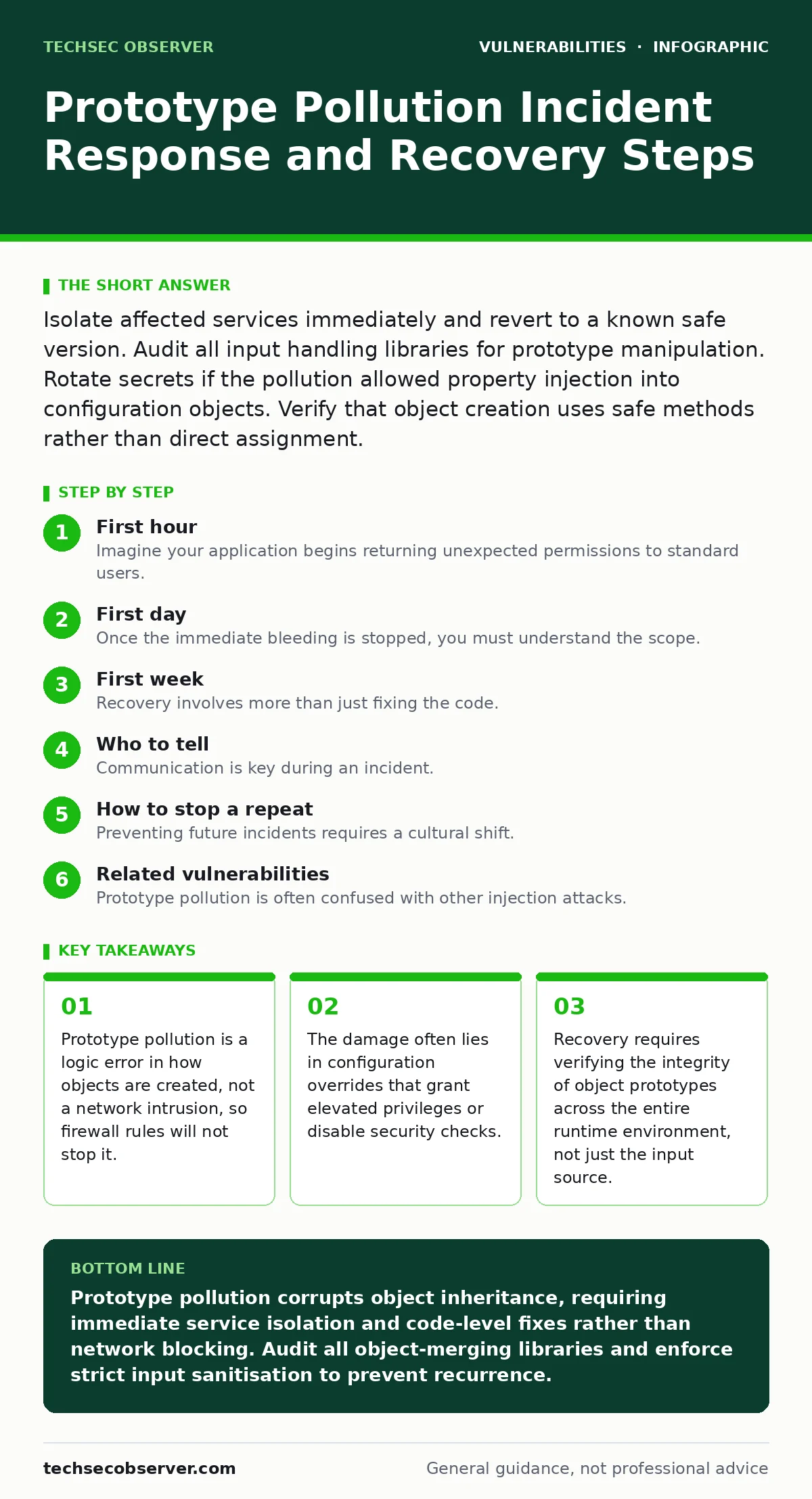
Isolate affected services immediately and revert to a known safe version. Audit all input handling libraries for prototype manipulation. Rotate secrets if the pollution allowed property injection into configuration objects. Verify that object creation uses safe methods rather than direct assignment.
First hour
Imagine your application begins returning unexpected permissions to standard users. The root cause is likely prototype pollution, where an attacker modifies the base object from which other objects inherit properties. This is not a network breach in the traditional sense. It is a corruption of the application’s internal logic.
Your first priority is containment. You must stop the polluted object from propagating to other parts of the system. If the pollution affects a shared library or a global configuration object, the damage spreads to every new instance created by the application.
- Identify the specific service or endpoint accepting the malicious input.
- Disable the endpoint or block traffic to it using your load balancer.
- Snapshot the memory state of the affected process for later analysis.
- Revert the application to the last known good version if possible.
This approach limits the blast radius. Prototype pollution exploits the inheritance chain of objects. By stopping the input, you halt the infection vector. However, the polluted prototype may already exist in memory. You must treat the current runtime as untrusted.
First day
Once the immediate bleeding is stopped, you must understand the scope. Prototype pollution allows an attacker to add properties to the Object.prototype. These properties then appear on every object that does not explicitly override them. This can lead to remote code execution if the application merges user input with internal data structures.
You need to determine what properties were added. Common targets include __proto__, constructor, and prototype. Attackers use these to inject malicious functions or values. For example, adding a toString method can crash the application or execute code when the object is converted to a string.
Check your logs for unusual property names. Look for keys that contain dots or brackets in JSON payloads. These are often used to traverse or create nested objects. The pattern { "key": { "__proto__": { "isAdmin": true } } } is a classic example. This input sets isAdmin to true for all objects in the application.
If the pollution affected configuration files or environment variables, you must rotate any secrets that were exposed. The attacker may have injected properties that bypass authentication or logging. Treat all credentials as compromised until you prove otherwise.
First week
Recovery involves more than just fixing the code. You must ensure that the polluted state is fully eradicated. This requires a thorough review of how objects are created and merged in your application. Direct assignment of properties is dangerous. Use safe methods that do not traverse the prototype chain.
For instance, use Object.create(null) to create objects without a prototype. This prevents attackers from adding properties to the base object. Alternatively, use libraries that explicitly ignore prototype properties during merging. These libraries check for __proto__ and other dangerous keys before processing input.
You should also implement runtime checks. Detecting prototype pollution early can prevent damage. Monitor for unexpected properties on objects. If an object has a property that was not defined in its class, flag it as suspicious. This adds a layer of defence that catches errors before they become exploits.
This incident highlights the fragility of object-oriented programming in dynamic languages. The convenience of inheritance comes with the risk of pollution. You must balance flexibility with security. Every place where user input is merged with internal data is a potential attack surface.
Who to tell
Communication is key during an incident. You must inform your team, stakeholders, and potentially affected users. Be precise about what happened. Avoid technical jargon when speaking to non-technical stakeholders. Explain that the application’s internal logic was manipulated, not that data was stolen directly.
Tell your development team to review all input handling code. Emphasise the importance of using safe object creation methods. Share the findings from your forensic analysis. This helps prevent similar incidents in the future.
If user data was exposed or if the pollution allowed access to other users’ data, you must notify those users. Follow your local regulations for data breach notification. Be transparent about the steps you have taken to secure the application.
How to stop a repeat
Preventing future incidents requires a cultural shift. Developers must understand the risks of prototype pollution. Training should cover safe coding practices and the importance of input validation. Code reviews should focus on object manipulation logic.
Integrate security testing into your CI/CD pipeline. Use tools that detect prototype pollution vulnerabilities. These tools can scan your code for dangerous patterns. They can also test your application with malicious inputs to find weaknesses.
Consider using a language or framework that does not suffer from prototype pollution. Some languages have stricter object models that prevent this type of attack. If you cannot change languages, enforce strict coding standards.
Regularly update your dependencies. New versions of libraries often fix known vulnerabilities. Use software composition analysis to track the health of your supply chain. This helps you stay ahead of emerging threats.
Related vulnerabilities
Prototype pollution is often confused with other injection attacks. It is distinct from SQL injection, which targets database queries. It is also different from command injection, which executes system commands. Understanding these differences helps you apply the right fixes.
Open redirect vulnerabilities allow attackers to redirect users to malicious sites. This is a client-side issue, whereas prototype pollution is server-side. VPN appliance vulnerabilities often involve weak authentication or outdated software. These are infrastructure issues, not application logic errors.
A CVSS score helps you prioritise fixes. Prototype pollution can have a high score due to its potential for remote code execution. However, the impact depends on the specific application. Use the score to guide your response efforts.
Fuzz testing can help find prototype pollution vulnerabilities. By sending random inputs to your application, you can trigger unexpected behaviour. Purple teaming exercises can also reveal weaknesses in your detection and response capabilities.
Final checks
Before declaring the incident closed, perform a final review. Ensure that all patches are applied. Verify that monitoring is in place to detect similar attacks. Update your incident response plan to include prototype pollution scenarios.
Document the lessons learned. Share them with your team. This builds a culture of security awareness. It also helps you improve your processes for future incidents.
Remember that security is an ongoing process. There is no final state of complete protection. You must continuously adapt to new threats. Stay informed about emerging vulnerabilities and best practices.
Key takeaways
- Prototype pollution is a logic error in how objects are created, not a network intrusion, so firewall rules will not stop it.
- The damage often lies in configuration overrides that grant elevated privileges or disable security checks.
- Recovery requires verifying the integrity of object prototypes across the entire runtime environment, not just the input source.
Prototype pollution corrupts object inheritance, requiring immediate service isolation and code-level fixes rather than network blocking. Audit all object-merging libraries and enforce strict input sanitisation to prevent recurrence.
Frequently asked questions
Can prototype pollution lead to data theft?
Yes, if the polluted prototype allows access to sensitive properties or bypasses authentication checks, attackers can exfiltrate data.
Does HTTPS prevent prototype pollution?
No, HTTPS encrypts data in transit but does not protect against logic errors in how the application processes that data.
How do I detect prototype pollution in logs?
Look for unusual property names like __proto__ or constructor in JSON payloads and for unexpected property values on objects.
Is prototype pollution common in Python?
Python is less susceptible due to its different object model, but similar issues can arise with metaclasses or attribute manipulation.
How this guide was produced: written by the TechSec Observer editorial team with AI assistance, checked against the public references listed below, and reviewed when the facts change. See our editorial policy or report an error.