Why CVSS Scores Matter for Real-World Security Decisions
Relying solely on CVSS metrics creates blind spots that leave critical infrastructure exposed to sophisticated, low-scoring attack paths.

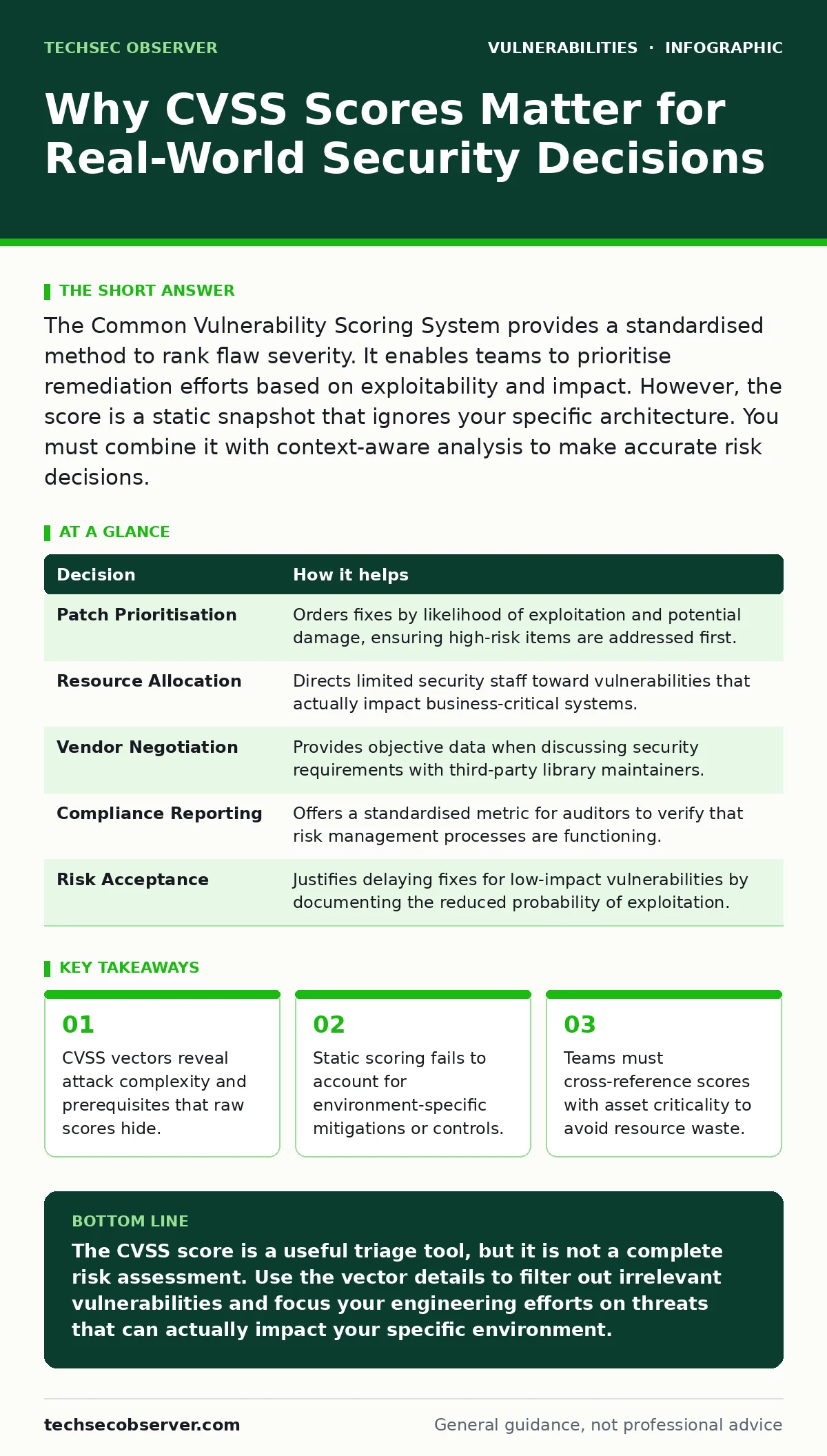
The Common Vulnerability Scoring System provides a standardised method to rank flaw severity. It enables teams to prioritise remediation efforts based on exploitability and impact. However, the score is a static snapshot that ignores your specific architecture. You must combine it with context-aware analysis to make accurate risk decisions.
The Illusion of Universal Severity
You cannot measure technical debt with a single ruler, yet many teams treat vulnerability scores as absolute truth. The Common Vulnerability Scoring System (CVSS) is a framework used to capture the principal characteristics of a vulnerability and produce a numerical score reflecting its severity. This score ranges from zero to ten, with ten representing the most severe potential impact. While this number offers a quick glance at danger, it lacks the nuance required for precise engineering decisions. A score of nine does not automatically mean you must drop everything to fix the issue today.
The metric calculates severity based on base metrics like attack vector, complexity, and privileges required. It also includes temporal and environmental metrics that adjust the score based on exploit code availability or specific environmental configurations. Understanding these layers is the first step toward using the data effectively. If you only look at the final number, you miss the story the vector string tells about how an attacker might operate.
How Teams Operationalise the Score
Development and security teams use these scores to triage incoming vulnerability reports. When a new flaw is disclosed in a library, the score helps determine whether to patch immediately or schedule the fix for the next release cycle. High scores typically trigger urgent incident response procedures, while lower scores might enter the standard backlog. This triage process prevents teams from being overwhelmed by the volume of disclosed flaws.
However, the score is just one input in a larger decision matrix. You must weigh the score against the criticality of the affected asset. A minor flaw in a public-facing authentication gateway carries more risk than a severe flaw in an internal development server that never touches production data. By integrating scores with asset inventory data, teams create a dynamic risk profile rather than a static list of problems. This approach ensures that security efforts align with business continuity goals.
Decisions Informed by Granular Data
The true value of the system lies not in the number, but in the breakdown of how that number was calculated. Each score is accompanied by a vector string that details the specific conditions required for exploitation. These conditions include the attack vector, such as network or local access, and the user interaction required, such as none or required. This granularity allows you to filter vulnerabilities that do not apply to your architecture.
For instance, if your application runs in an air-gapped environment, any vulnerability requiring a network attack vector is irrelevant. You can safely deprioritise these items without further investigation. Similarly, if a flaw requires high privileges, but your system enforces strict least-privilege policies, the effective risk is lower than the base score suggests. Using this data prevents wasted engineering hours on theoretical threats that cannot materialise in your specific context.
| Decision | How it helps |
|---|---|
| Patch Prioritisation | Orders fixes by likelihood of exploitation and potential damage, ensuring high-risk items are addressed first. |
| Resource Allocation | Directs limited security staff toward vulnerabilities that actually impact business-critical systems. |
| Vendor Negotiation | Provides objective data when discussing security requirements with third-party library maintainers. |
| Compliance Reporting | Offers a standardised metric for auditors to verify that risk management processes are functioning. |
| Risk Acceptance | Justifies delaying fixes for low-impact vulnerabilities by documenting the reduced probability of exploitation. |
What Goes Wrong Without Context
Relying exclusively on raw scores leads to significant operational inefficiencies. Teams often chase high scores that pose no real threat to their environment, leaving lower-scoring but highly exploitable issues unaddressed. This is known as score fatigue. Developers become desensitised to security alerts when they are forced to fix issues that do not align with their actual risk profile.
Furthermore, high scores can mask subtle logic errors that have lower numerical values but higher strategic impact. Consider a flaw that allows an attacker to manipulate internal state without direct code execution. Such an issue might score lower than a remote code execution flaw, but it could be easier to exploit at scale. Without deeper analysis, teams miss these nuanced threats. This is where techniques like fuzz testing can help uncover edge cases that static scoring models overlook by probing the system with unexpected inputs.
The Hidden Cost of Automated Triaging
Many security platforms automatically assign risk levels based on scores. While this automation speeds up initial processing, it introduces a hidden cost: false confidence. Automated systems often lack the context to understand your specific deployment topology. They may flag a vulnerability as critical because it affects a widely used library, even if your application does not use the vulnerable function.
This disconnect forces engineers to spend time verifying false positives rather than fixing real issues. To mitigate this, you must implement software composition analysis tools that map dependencies accurately. These tools provide the necessary context to validate whether a scored vulnerability actually affects your codebase. Without this validation, your security posture is built on assumptions rather than evidence.
See also: IoT Patching Mistakes: 7 Errors That Leave Devices Exposed · Prevent Business Logic Vulnerabilities: 4 Proven Measures
Integrating with Broader Security Practices
Vulnerability scoring is most effective when combined with other security disciplines. For example, understanding SQL injection flaws requires more than just a score; it requires knowledge of how your application handles user input. A high score indicates the potential for data breach, but your specific input validation strategies determine the actual likelihood.
Similarly, when dealing with Bluetooth security in IoT devices, the physical proximity required for an attack changes the risk calculus. A high score might suggest immediate remediation, but if the device is used in a controlled environment where attackers cannot get within range, the priority shifts. By contextualising scores with domain-specific knowledge, you create a more resilient security strategy. This integration ensures that you are not just closing tickets, but actually reducing risk.
Moving Beyond the Number
The goal is not to eliminate all high scores, but to manage the ones that matter. You should treat the score as a starting point for investigation, not a final verdict. Engage with your development teams to understand why a vulnerability exists and how it interacts with your system. This collaborative approach builds a culture of security that goes beyond compliance checklists.
Regularly review your triage processes to ensure they remain aligned with your evolving architecture. As your systems change, the relevance of certain attack vectors changes too. A flaw that was once critical may become irrelevant due to new network segmentation. By staying adaptable, you ensure that your security efforts remain effective and efficient. This continuous improvement is the key to maintaining a strong defence against emerging threats.
Key takeaways
- CVSS vectors reveal attack complexity and prerequisites that raw scores hide.
- Static scoring fails to account for environment-specific mitigations or controls.
- Teams must cross-reference scores with asset criticality to avoid resource waste.
The CVSS score is a useful triage tool, but it is not a complete risk assessment. Use the vector details to filter out irrelevant vulnerabilities and focus your engineering efforts on threats that can actually impact your specific environment.
Frequently asked questions
Should I fix a vulnerability with a score of zero?
A score of zero typically indicates no known exploitability or impact, but you should still review it to ensure it does not represent a logical flaw that could be chained with other issues.
How do I handle conflicting scores from different sources?
Different scanners may use different CVSS versions or environmental assumptions. Trust your own internal assessment of the asset's exposure and consult the vendor's advisory for clarity.
Can I automate patching based on scores?
Automation is possible but risky. Only automate for high-confidence, low-risk patches. Always test automated fixes in a staging environment to prevent breaking functionality.
What is the difference between base and environmental scores?
The base score reflects the intrinsic properties of the vulnerability. The environmental score adjusts this based on your specific context, such as the presence of mitigating controls or asset criticality.
How this guide was produced: written by the TechSec Observer editorial team with AI assistance, checked against the public references listed below, and reviewed when the facts change. See our editorial policy or report an error.