Vulnerability Remediation SLAs: 8 Practices for Faster Patching
Static time limits ignore deployment friction, causing teams to patch low-risk issues first while critical flaws remain exposed in production systems.

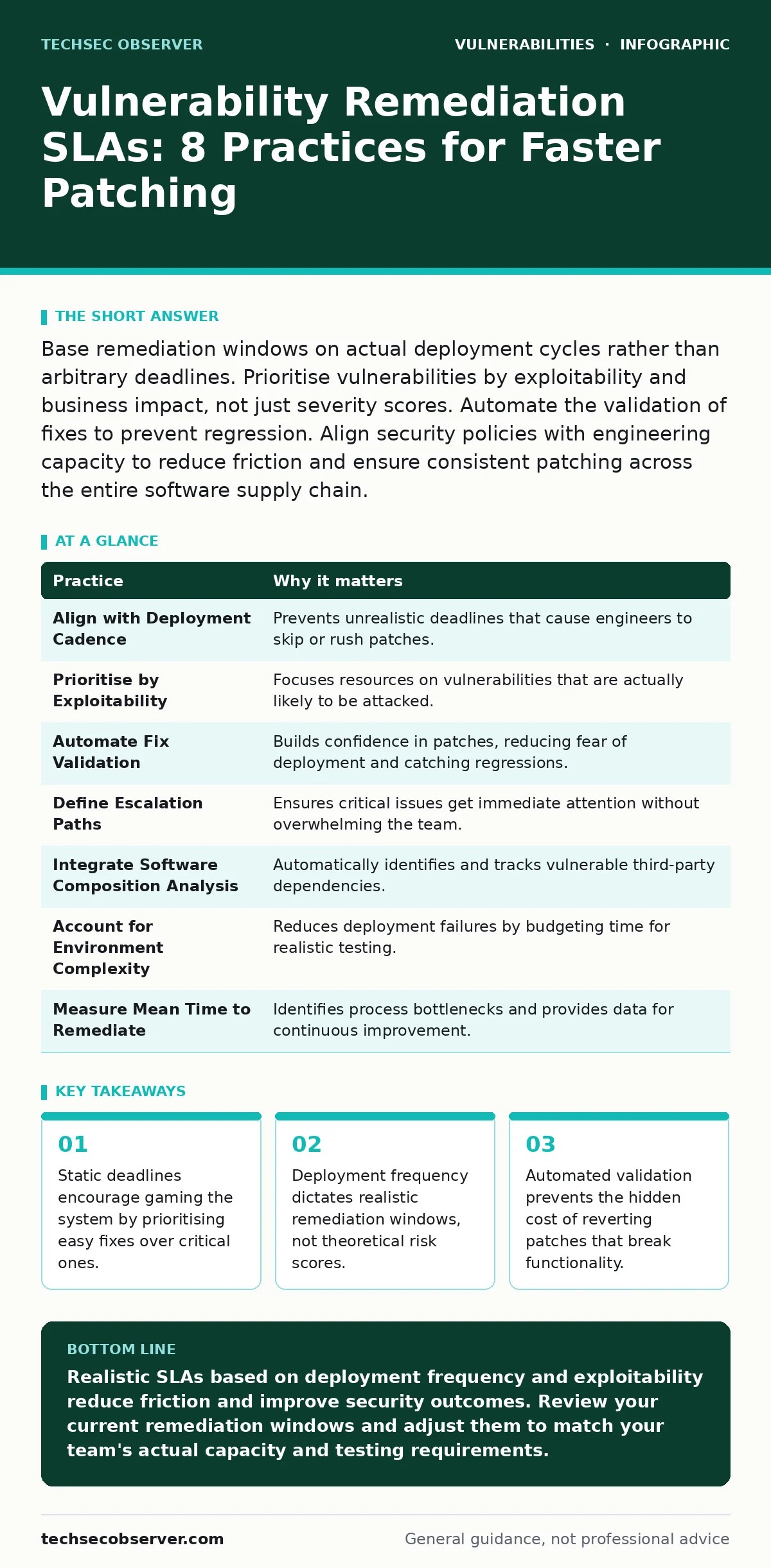
Base remediation windows on actual deployment cycles rather than arbitrary deadlines. Prioritise vulnerabilities by exploitability and business impact, not just severity scores. Automate the validation of fixes to prevent regression. Align security policies with engineering capacity to reduce friction and ensure consistent patching across the entire software supply chain.
Align SLAs with Deployment Cadence
Remediation Service Level Agreements must reflect how often your team actually ships code. A 24-hour patch window is useless if you deploy monthly. When security mandates clash with release cycles, engineers often defer patches or apply them inconsistently. This creates a false sense of security while leaving older, unpatched versions running in production. You need to map your SLA tiers to your release schedule. If you deploy weekly, a 7-day SLA for high-severity issues is realistic. A 1-day SLA creates panic and technical debt.
Prioritise by Exploitability, Not Just Severity
Common Vulnerability Scoring System scores measure theoretical impact, not likelihood. A score of 10.0 for a local privilege escalation is less urgent than a 7.5 for a remote code execution flaw. Engineers waste time patching high-severity, low-exploitability issues while leaving the door open for easy attacks. Focus on vulnerabilities that are actively exploited in the wild or easily reachable from the internet. This approach reduces the attack surface more effectively than chasing the highest numbers on a report. It also aligns security efforts with the actual threats facing your infrastructure.
Automate Fix Validation
Patching a vulnerability without verifying the fix is risky. A patch might resolve the security issue but break application functionality. Manual testing is slow and prone to human error. When you automate the validation of security fixes within your continuous integration pipeline, you catch regressions before they reach production. This reduces the fear of deploying patches. Engineers are more likely to apply updates promptly when they trust the automated test suite to verify stability. Automation also provides a clear audit trail for compliance requirements.
Define Clear Escalation Paths
Not all vulnerabilities require the same response speed. Establishing clear escalation paths ensures that critical issues get immediate attention without clogging the pipeline. Define who is responsible for each tier of remediation. For example, a critical remote code execution flaw might require immediate intervention from the security engineering team. A low-severity information disclosure might be handled by the development team during the next scheduled sprint. Clear ownership prevents the "bystander effect" where everyone assumes someone else will handle the patch. It also streamlines communication during incident response.
Integrate Software Composition Analysis
Third-party dependencies are a major source of vulnerabilities. Manual tracking of library versions is impossible at scale. Integrating Software Composition Analysis tools into your build process identifies vulnerable dependencies automatically. This allows you to set SLAs for dependency updates that are separate from application code patches. You can mandate that no new vulnerable libraries are merged into the main branch. This proactive approach prevents vulnerabilities from entering the codebase in the first place. It also simplifies remediation by providing direct links to updated, secure versions of the affected packages.
See also: Prevent Business Logic Vulnerabilities: 4 Proven Measures · Regular Expression Denial of Service Prevention Checklist
Account for Environment Complexity
Patching a development environment is easier than patching a production cluster with multiple dependencies. Complex environments introduce hidden risks. A patch might work in isolation but fail when interacting with other services. Your SLAs must account for the time required to test patches in staging environments that mirror production. This includes database schema changes, configuration updates, and compatibility checks with other systems. Ignoring this complexity leads to rushed patches that cause outages. Budgeting time for thorough testing in realistic environments reduces the risk of deployment failures and ensures a smoother remediation process.
Measure Mean Time to Remediate
Tracking the average time taken to fix vulnerabilities provides insight into your team's capacity and process efficiency. Mean Time to Remediate (MTTR) is a better metric than simple compliance rates. It highlights bottlenecks in your workflow. If MTTR increases for certain types of vulnerabilities, investigate why. Is it due to lack of documentation, complex dependencies, or insufficient testing tools? Use this data to improve your processes. Regularly reviewing MTTR helps you adjust your SLAs to be more realistic and achievable. It also demonstrates the value of security investments to stakeholders by showing improved response times.
Review and Adjust Regularly
Security landscapes and engineering practices evolve. SLAs that worked last year may be obsolete today. Regular reviews ensure your policies remain effective and aligned with current realities. Involve developers, security engineers, and operations teams in these reviews. Gather feedback on what works and what causes friction. Adjust SLA tiers based on new threat intelligence and changes in deployment frequency. This iterative process keeps your remediation strategy agile and responsive. It also fosters a culture of continuous improvement rather than rigid compliance. Regular adjustments prevent SLAs from becoming bureaucratic hurdles that hinder rather than help security efforts.
| Practice | Why it matters |
|---|---|
| Align with Deployment Cadence | Prevents unrealistic deadlines that cause engineers to skip or rush patches. |
| Prioritise by Exploitability | Focuses resources on vulnerabilities that are actually likely to be attacked. |
| Automate Fix Validation | Builds confidence in patches, reducing fear of deployment and catching regressions. |
| Define Escalation Paths | Ensures critical issues get immediate attention without overwhelming the team. |
| Integrate Software Composition Analysis | Automatically identifies and tracks vulnerable third-party dependencies. |
| Account for Environment Complexity | Reduces deployment failures by budgeting time for realistic testing. |
| Measure Mean Time to Remediate | Identifies process bottlenecks and provides data for continuous improvement. |
| Review and Adjust Regularly | Keeps policies relevant and aligned with current engineering practices and threats. |
Balancing Speed and Stability
The tension between rapid patching and system stability is real. Pushing for faster remediation without adequate testing increases the risk of outages. A balanced approach recognises that stability is a security requirement. An unstable system is vulnerable to denial of service and can distract teams from addressing genuine threats.
When you integrate security into the development lifecycle, you reduce the need for emergency patches. Proactive measures, such as secure coding practices and regular dependency updates, lower the overall vulnerability count. This makes remediation less stressful and more predictable. It also allows teams to focus on high-value security improvements rather than constant firefighting.
Imagine a team that receives a notification for a critical vulnerability in a core library. The SLA requires a fix within 24 hours. The team applies the patch, but it breaks a key feature. They revert the change, missing the SLA. The vulnerability remains. A better approach would have been to validate the fix in a staging environment that mirrors production dependencies. This extra step takes time but prevents the outage. The SLA should account for this validation time. By building realistic buffers into your SLAs, you encourage thoroughness over haste. This leads to more reliable systems and fewer security incidents caused by rushed deployments.
Key takeaways
- Static deadlines encourage gaming the system by prioritising easy fixes over critical ones.
- Deployment frequency dictates realistic remediation windows, not theoretical risk scores.
- Automated validation prevents the hidden cost of reverting patches that break functionality.
Realistic SLAs based on deployment frequency and exploitability reduce friction and improve security outcomes. Review your current remediation windows and adjust them to match your team's actual capacity and testing requirements.
Frequently asked questions
How do I handle vulnerabilities with no available patch?
Implement compensating controls such as web application firewalls or network segmentation to mitigate the risk until a patch is released.
Should all teams follow the same remediation SLAs?
No. Teams with different deployment frequencies and risk profiles
How this guide was produced: written by the TechSec Observer editorial team with AI assistance, checked against the public references listed below, and reviewed when the facts change. See our editorial policy or report an error.