Bot Protection Checklist: Defend APIs and Forms From Automated Abuse
Static rules fail against modern bots because they mimic human behaviour, requiring dynamic validation and behavioural analysis to distinguish legitimate users from automated scripts.

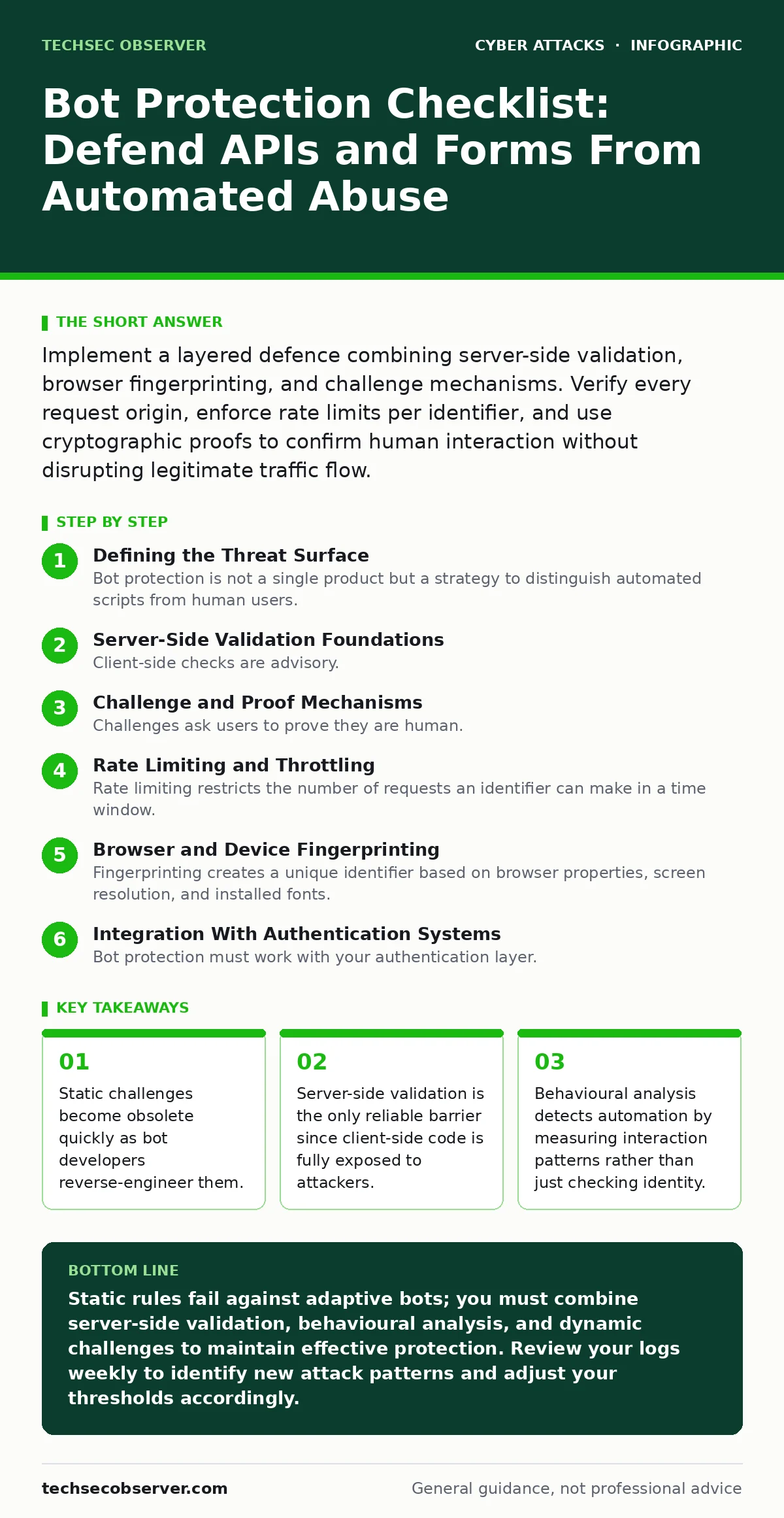
Implement a layered defence combining server-side validation, browser fingerprinting, and challenge mechanisms. Verify every request origin, enforce rate limits per identifier, and use cryptographic proofs to confirm human interaction without disrupting legitimate traffic flow.
Defining the Threat Surface
Bot protection is not a single product but a strategy to distinguish automated scripts from human users. You must decide which endpoints require protection. Public forms, login pages, and high-value APIs are primary targets. Internal tools may need lighter controls, but public-facing services require rigorous verification.
Imagine a script scraping your pricing page to feed a competitor’s algorithm. This is low-value abuse. Now suppose that script attempts to brute-force your login endpoint. This is high-value abuse. Your defence must scale with the threat level.
Server-Side Validation Foundations
Client-side checks are advisory. A determined attacker can bypass JavaScript validation entirely. You must treat every incoming request as untrusted. Validate input types, lengths, and formats on the server. Reject malformed data immediately.
This approach prevents injection attacks and reduces server load. It also ensures that your application state remains consistent regardless of how the request arrives.
- Enforce strict input validation: Reject data that does not match expected schemas to prevent injection and parsing errors.
- Verify request origins: Check headers and referers to ensure traffic comes from your domain, reducing cross-site request forgery risks.
- Implement idempotency keys: Ensure duplicate requests are handled safely, preventing accidental double-processing by automated clients.
Challenge and Proof Mechanisms
Challenges ask users to prove they are human. Traditional image-based tests are easily solved by machine learning models. Modern approaches use invisible challenges or behavioural verification. These methods analyse mouse movements, timing, and interaction patterns.
The trade-off is privacy and complexity. You collect more data to make a better decision. You must balance security with user experience. A challenge that is too hard blocks legitimate users. One that is too easy lets bots through.
- Deploy invisible proof-of-work: Require computational effort that is negligible for browsers but costly for mass botnets.
- Use behavioural biometrics: Analyse interaction patterns like typing rhythm and cursor paths to detect non-human behaviour.
- Rotate challenge parameters: Change the cryptographic parameters frequently to prevent bots from caching solutions.
Rate Limiting and Throttling
Rate limiting restricts the number of requests an identifier can make in a time window. This slows down brute-force attacks and scraping. You must define the limit carefully. Too strict, and you block legitimate high-traffic users. Too loose, and bots operate freely.
Use a sliding window algorithm for fairness. Fixed windows can be exploited by sending requests just before the window resets. Sliding windows smooth out these spikes.
- Set per-IP rate limits: Restrict requests from single sources to mitigate direct scanning and brute-force attempts.
- Implement per-account throttling: Limit actions for authenticated users to prevent account takeover and credential stuffing.
- Apply exponential backoff: Increase delays for repeated failures, making sustained attacks economically unviable.
Browser and Device Fingerprinting
Fingerprinting creates a unique identifier based on browser properties, screen resolution, and installed fonts. This helps link requests across sessions. It is useful for detecting headless browsers, which often lack certain features of real browsers.
However, fingerprinting raises privacy concerns. Some jurisdictions restrict the collection of such data. You must inform users and obtain consent where required. Also, legitimate users using privacy tools may appear as bots.
- Check for headless browser markers: Identify automated browsers that do not render standard JavaScript or CSS features.
- Validate TLS fingerprints: Analyse the initial handshake to detect known bot client libraries.
- Monitor for device inconsistencies: Flag requests where the reported device type conflicts with the user-agent string.
Integration With Authentication Systems
Bot protection must work with your authentication layer. If a bot bypasses the login, your other defences are irrelevant. Use multi-factor authentication to add a layer bots cannot easily replicate. However, even MFA can be bypassed if the initial credential is stolen.
Consider the related risks of social engineering, where attackers trick users into revealing codes. Your bot defence should flag unusual login locations or times, triggering additional verification steps.
- Enforce phishing-resistant authentication: Use hardware keys or platform authenticators that are resistant to remote interception.
- Monitor for credential stuffing: Detect rapid login attempts with different passwords from the same IP or user agent.
- Validate OAuth tokens carefully: Ensure tokens are issued to trusted clients and have appropriate scopes to prevent OAuth token abuse.
Monitoring and Response Strategy
No system is perfect. You must monitor for new bot signatures and adjust your rules. Log all blocked requests and analyse them for patterns. Look for new user-agent strings or unusual header combinations.
Respond to attacks dynamically. If a specific IP range becomes hostile, block it temporarily. If a new challenge is being bypassed, rotate it immediately. This continuous adaptation is key to long-term security.
- Log and analyse blocked traffic: Identify new attack vectors and adjust your rules to catch emerging threats.
- Set up alerting for anomalies: Notify administrators when traffic patterns deviate significantly from the baseline.
- Regularly update bot signatures: Keep your detection rules current with the latest known bot frameworks and techniques.
Key takeaways
- Static challenges become obsolete quickly as bot developers reverse-engineer them.
- Server-side validation is the only reliable barrier since client-side code is fully exposed to attackers.
- Behavioural analysis detects automation by measuring interaction patterns rather than just checking identity.
Static rules fail against adaptive bots; you must combine server-side validation, behavioural analysis, and dynamic challenges to maintain effective protection. Review your logs weekly to identify new attack patterns and adjust your thresholds accordingly.
Frequently asked questions
How do I stop bots from scraping my content?
Implement rate limiting per IP and use invisible proof-of-work challenges. Monitor for unusual traffic patterns and block sources that exceed reasonable usage limits.
Can bots bypass multi-factor authentication?
Bots cannot easily bypass MFA if the second factor is hardware-based or tied to a specific device. However, they can exploit user errors or phishing to obtain codes.
What is the difference between a bot and a crawler?
Crawlers are automated agents that index content, often respecting robots.txt. Bots are automated agents that perform actions, such as logging in or submitting forms, often maliciously.
How often should I update my bot protection rules?
Update rules immediately when you detect a new attack pattern. Review and rotate challenge parameters regularly to prevent bots from adapting to static defences.
How this guide was produced: written by the TechSec Observer editorial team with AI assistance, checked against the public references listed below, and reviewed when the facts change. See our editorial policy or report an error.