Why is credential stuffing considered an authentication failure
Credential stuffing exposes a systemic flaw in identity verification where the system validates data rather than proving the user's actual presence.

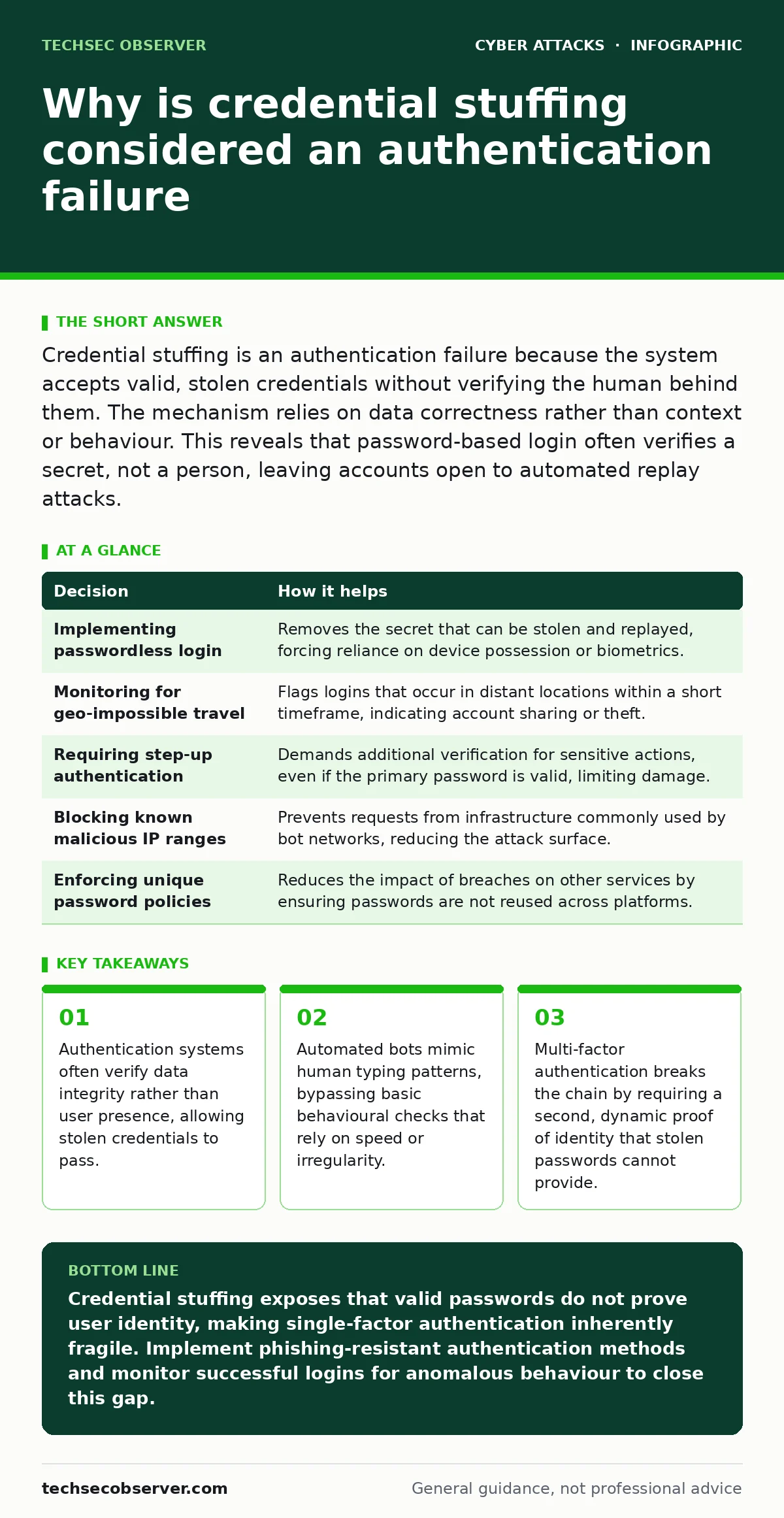
Credential stuffing is an authentication failure because the system accepts valid, stolen credentials without verifying the human behind them. The mechanism relies on data correctness rather than context or behaviour. This reveals that password-based login often verifies a secret, not a person, leaving accounts open to automated replay attacks.
The core mechanism of credential stuffing
Credential stuffing occurs when attackers use automated tools to submit large lists of stolen username and password combinations against various websites. The attack succeeds because many users reuse passwords across different services. When an attacker obtains credentials from one breach, they test those same credentials on banking, email, or shopping sites.
The system accepts the login if the data matches its database. This process highlights a fundamental weakness in how digital identity is verified. The system checks whether the provided secret matches the stored secret. It does not check whether the person typing the secret is the legitimate owner. This distinction is critical for understanding why standard password protection often fails against determined attackers.
Why is credential stuffing considered an authentication failure
Credential stuffing is considered an authentication failure because the authentication protocol validates data correctness rather than user presence. The system confirms that the password hash matches the stored hash. It does not confirm that a human being initiated the request. This creates a gap where any entity possessing the correct data can gain access.
The failure lies in the design assumption that a secret known only to the user equals the user themselves. When that secret is exposed, the equivalence breaks. The system continues to function as designed, granting access to valid data. However, the security model has failed to distinguish between a legitimate user and an attacker holding stolen keys. This is a structural flaw in single-factor authentication methods.
The role of automation and bot networks
Attackers use sophisticated bot networks to perform credential stuffing at scale. These bots rotate IP addresses to avoid simple blocklists. They mimic human typing speeds and mouse movements to evade basic behavioural analysis. Some bots even solve CAPTCHAs using remote solving services or machine learning models. This automation allows attackers to test millions of credential pairs in minutes.
The speed of the attack outpaces the ability of manual security teams to respond. Traditional rate limiting often fails because the bots distribute requests across many accounts and IP ranges. The system sees many legitimate-looking login attempts rather than one massive assault. This distribution makes the attack difficult to detect using volume-based thresholds alone.
The hidden cost of valid credentials
The most insidious aspect of credential stuffing is that the credentials are valid. The user has not changed their password. The user may not even know their details were compromised elsewhere. When the login succeeds, the system logs it as a successful authentication event. This generates no immediate alert. Security teams often focus on failed login attempts as indicators of compromise.
Successful logins with valid credentials bypass these detection mechanisms. The attacker gains access silently. They may wait days or weeks before exfiltrating data or making purchases. This delay makes it difficult to correlate the breach with the initial entry point. The organisation suffers a data loss while its security metrics show normal authentication activity.
Comparing defensive strategies
Organisations must choose how to harden their authentication layers. Each approach addresses a different part of the attack chain. Some measures focus on detection, while others focus on prevention. The table below outlines common decisions and their specific impact on credential stuffing resistance.
| Decision | How it helps |
|---|---|
| Implementing passwordless login | Removes the secret that can be stolen and replayed, forcing reliance on device possession or biometrics. |
| Monitoring for geo-impossible travel | Flags logins that occur in distant locations within a short timeframe, indicating account sharing or theft. |
| Requiring step-up authentication | Demands additional verification for sensitive actions, even if the primary password is valid, limiting damage. |
| Blocking known malicious IP ranges | Prevents requests from infrastructure commonly used by bot networks, reducing the attack surface. |
| Enforcing unique password policies | Reduces the impact of breaches on other services by ensuring passwords are not reused across platforms. |
The limits of behavioural analysis
Many organisations rely on behavioural analysis to detect credential stuffing. These systems track typing rhythm, mouse movement, and session duration. The assumption is that bots cannot perfectly mimic human quirks. However, modern bot frameworks are designed to randomise these behaviours. They introduce slight delays and variations to appear human.
This makes behavioural analysis less reliable as a standalone defence. It becomes a noisy signal with many false positives and false negatives. Users with disabilities or those using assistive technology may trigger these alerts. The system must balance security with accessibility. Over-reliance on behavioural metrics can lead to blocking legitimate users while sophisticated bots slip through.
Integrating phishing-resistant authentication
The most effective defence against credential stuffing is removing the password from the equation entirely. Phishing-resistant authentication methods, such as FIDO2 security keys or platform authenticators, bind the authentication to the specific domain and device. An attacker cannot use a stolen credential from another site because the cryptographic proof is tied to the original service.
This breaks the reuse chain that credential stuffing relies on. Even if the attacker has the user's password, they cannot generate the required cryptographic signature without the physical device. This approach shifts the security model from something you know to something you have. It eliminates the possibility of replaying stolen secrets across different services.
What to do with this knowledge
Understanding that credential stuffing is an authentication failure requires a shift in how you design login systems. You must stop assuming that a valid password means a valid user. Implement monitoring for successful logins from new devices or locations. These events are often more indicative of compromise than failed attempts.
Encourage users to adopt password managers to generate unique passwords for every site. This limits the blast radius of any single breach. Consider moving towards phishing-resistant authentication for high-value accounts. This provides a stronger guarantee of user identity than passwords alone. Regularly review authentication logs for anomalies that suggest automated activity.
The broader context of identity security
Credential stuffing is part of a larger landscape of identity-based attacks. It often precedes more sophisticated threats. Attackers may use stolen credentials to launch supply chain attacks if they gain access to developer accounts. They may use the access to create deepfake scams by harvesting personal data for social engineering.
Understanding the failure of password-only authentication helps you appreciate the need for layered security. Endpoint protection alone cannot stop an attacker who has valid login credentials. Security awareness training helps users recognise phishing, but it cannot protect against reused passwords. A holistic approach combines technical controls with user education and robust authentication standards.
Key takeaways
- Authentication systems often verify data integrity rather than user presence, allowing stolen credentials to pass.
- Automated bots mimic human typing patterns, bypassing basic behavioural checks that rely on speed or irregularity.
- Multi-factor authentication breaks the chain by requiring a second, dynamic proof of identity that stolen passwords cannot provide.
Credential stuffing exposes that valid passwords do not prove user identity, making single-factor authentication inherently fragile. Implement phishing-resistant authentication methods and monitor successful logins for anomalous behaviour to close this gap.
Frequently asked questions
How do attackers get the credentials for stuffing attacks?
Attackers obtain credentials from previous data breaches on other websites. They purchase these lists on underground markets or scrape them from public leaks. Many users reuse passwords, making these lists effective across multiple services.
Can two-factor authentication stop credential stuffing?
Two-factor authentication significantly reduces the risk by requiring a second proof of identity. However, if the second factor is SMS or email, it can be intercepted. Phishing-resistant methods like hardware keys provide stronger protection against this threat.
Why do rate limiting and CAPTCHAs sometimes fail?
Modern bot networks rotate IP addresses and solve CAPTCHAs using automated services. They mimic human behaviour patterns to avoid detection. Rate limiting may block legitimate users if thresholds are too strict, while too loose limits allow bots to operate undetected.
What is the difference between credential stuffing and brute force?
Brute force attacks try many password combinations against a single account. Credential stuffing tries known username-password pairs from breaches against many accounts. The former guesses secrets, while the latter replays stolen ones.
How this guide was produced: written by the TechSec Observer editorial team with AI assistance, checked against the public references listed below, and reviewed when the facts change. See our editorial policy or report an error.