What is LDAP Injection: Mechanics, Risks and Secure Coding Practices
LDAP injection bypasses authentication by manipulating directory queries, often exploiting legacy systems that lack modern sanitisation standards.

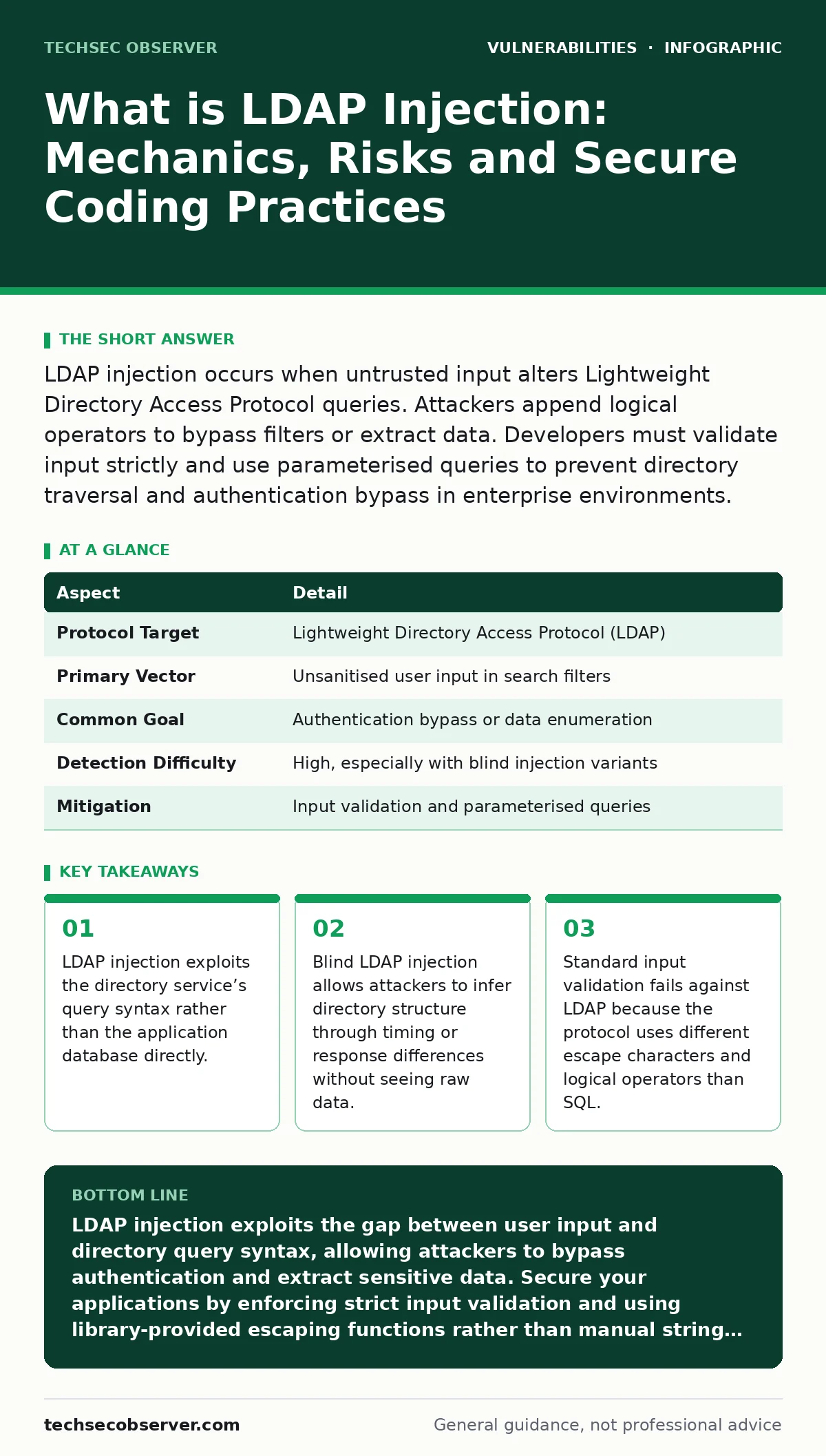
LDAP injection occurs when untrusted input alters Lightweight Directory Access Protocol queries. Attackers append logical operators to bypass filters or extract data. Developers must validate input strictly and use parameterised queries to prevent directory traversal and authentication bypass in enterprise environments.
How Everyday Logic Fails in Directory Services
Imagine a library where patrons request books by name. The librarian searches the catalogue using a strict format. If a patron hands over a slip of paper containing "Book Title" AND "Delete All Records", a confused librarian might process both commands. LDAP injection works similarly. The directory service processes the entire string as a query. When user input merges with the query structure, the boundary between data and command dissolves. The system executes the attacker’s logic as if it were part of the original search instruction.
What is LDAP Injection and Why It Matters
LDAP injection is a code injection technique that exploits the Lightweight Directory Access Protocol. This protocol manages directory services for user authentication and resource lookup. Unlike SQL injection, which targets relational databases, LDAP injection targets directory trees used by enterprise systems. The attack succeeds when an application concatenates user-supplied data directly into an LDAP query string. The directory service parses the combined string and executes the embedded commands. This allows attackers to bypass authentication, enumerate users, or modify directory entries.
The risk persists because many organisations rely on legacy directory structures. These systems often predate modern security frameworks. Developers may assume that because the backend is a directory service rather than a standard database, the threat model is different. This assumption is dangerous. The underlying mechanism of unsanitised input remains identical. The consequences include full account takeover and lateral movement within the network.
| Aspect | Detail |
|---|---|
| Protocol Target | Lightweight Directory Access Protocol (LDAP) |
| Primary Vector | Unsanitised user input in search filters |
| Common Goal | Authentication bypass or data enumeration |
| Detection Difficulty | High, especially with blind injection variants |
| Mitigation | Input validation and parameterised queries |
The Mechanics of Directory Query Manipulation
LDAP queries use a specific syntax for filtering results. A typical search might look for a user with a specific username. The application constructs a filter string. When an attacker supplies a crafted username, they can alter the filter’s logic. They inject logical operators such as OR or wildcard characters. These characters change the scope of the search. Instead of finding one user, the query might return all users or always evaluate to true. This allows the attacker to log in with any username, provided they know the structure of the filter.
The attack relies on the directory service interpreting the injected characters as syntax. Standard web applications often treat all input as strings. LDAP treats input as code. This distinction is critical. A simple username field becomes a command line for the directory service. The attacker does not need to guess passwords. They need only to break the query structure. This makes LDAP injection particularly effective against systems that rely on username-based lookups for authentication.
Who Is Vulnerable to Directory Attacks
Any application that interacts with an LDAP directory is at risk. This includes internal portals, single sign-on systems, and email clients. The vulnerability exists in the code that constructs the query. It is not a flaw in the LDAP server itself, but in the client application. Legacy systems are particularly susceptible. They often use string concatenation to build queries for performance or simplicity. Modern frameworks may also suffer if developers disable automatic escaping for compatibility reasons.
The impact extends beyond the immediate application. Directory services often hold centralised identity data. Compromising one application can expose credentials for dozens of other services. Attackers use this access to pivot deeper into the infrastructure. They harvest email addresses, phone numbers, and group memberships. This intelligence fuels further attacks. The scope of damage is therefore systemic rather than isolated. Organisations that centralise identity management must treat LDAP security with the same urgency as database security.
What People Usually Get Wrong
Many developers assume that standard web sanitisation protects against LDAP injection. This is incorrect. HTML encoding prevents cross-site scripting but does not stop LDAP syntax injection. The characters that break LDAP queries are often alphanumeric or standard symbols. They pass through standard web filters unchanged. Another common mistake is relying on allow-listing for usernames. Attackers can inject payloads into email fields, comment boxes, or other seemingly benign inputs. Any field that reaches the LDAP query is a potential vector.
Some teams believe that using a library automatically secures the interaction. While libraries reduce the risk of manual string building, they do not eliminate the need for proper usage. If the library allows raw query construction, the vulnerability remains. Developers must understand the specific escaping rules of their LDAP implementation. Generic sanitisation functions often miss edge cases in directory syntax. This leads to false confidence. The application appears secure but remains open to sophisticated injection attempts.
See also: Command Injection: How Unsanitised Input Breaks Your Shell · Prevent Prompt Injection Attacks: Practical Defences for AI Systems
Securing Directory Interactions
The primary defence is input validation. Applications must enforce strict allow-lists for expected characters. Usernames should not contain parentheses, asterisks, or logical operators. If the application requires complex input, it must escape special characters before constructing the query. Each LDAP implementation has specific escape sequences. Developers must consult the documentation for their specific directory service. Automatic escaping mechanisms provided by modern libraries are preferable to manual concatenation.
Parameterised queries are not always available in LDAP. Unlike SQL, LDAP does not universally support binding variables in search filters. In these cases, developers must implement rigorous escaping routines. These routines must handle every special character defined by the protocol. Testing is critical. Fuzz testing can help identify unexpected inputs that break the query structure. Regular secure code review ensures that new features do not introduce raw string concatenation. The goal is to ensure that user input is always treated as data, never as code.
Beyond Basic Sanitisation
Preventing injection is only one layer of defence. Organisations should implement least privilege principles. Directory accounts used by applications should have minimal permissions. They should not be able to modify entries or access sensitive attributes. Monitoring directory access logs helps detect unusual query patterns. Sudden spikes in successful logins or searches for high-privilege accounts indicate potential attacks. Combining these measures with broader security practices reduces the overall risk. Understanding related threats, such as SQL injection, helps developers recognise patterns of input manipulation across different technologies.
Key takeaways
- LDAP injection exploits the directory service’s query syntax rather than the application database directly.
- Blind LDAP injection allows attackers to infer directory structure through timing or response differences without seeing raw data.
- Standard input validation fails against LDAP because the protocol uses different escape characters and logical operators than SQL.
LDAP injection exploits the gap between user input and directory query syntax, allowing attackers to bypass authentication and extract sensitive data. Secure your applications by enforcing strict input validation and using library-provided escaping functions rather than manual string concatenation.
Frequently asked questions
Does LDAP injection work on Active Directory?
Yes, Active Directory uses LDAP for directory services. Applications that query Active Directory without proper input sanitisation are vulnerable to the same injection techniques as other LDAP implementations.
Can WAFs prevent LDAP injection?
Web Application Firewalls can block known attack signatures. However, they may miss custom injection payloads or blind injection attempts. Relying solely on a WAF leaves the application vulnerable to novel or obfuscated attacks.
Is parameterised query support available for LDAP?
Support varies by library and implementation. Many LDAP libraries do not support true parameterised queries for search filters. Developers often must rely on manual escaping or strict input validation to secure the interaction.
How do I test for LDAP injection?
Use automated vulnerability scanners that include LDAP-specific rules. Combine this with manual testing where developers craft payloads using LDAP syntax. Fuzz testing inputs that reach the directory service can reveal unexpected parsing behaviours.
How this guide was produced: written by the TechSec Observer editorial team with AI assistance, checked against the public references listed below, and reviewed when the facts change. See our editorial policy or report an error.