Synthetic Identity Fraud Meaning: How Fabricated Identities Evade Detection
Fraudsters assemble real and fake data to create new identities that bypass traditional credit checks and age into legitimate profiles over time.

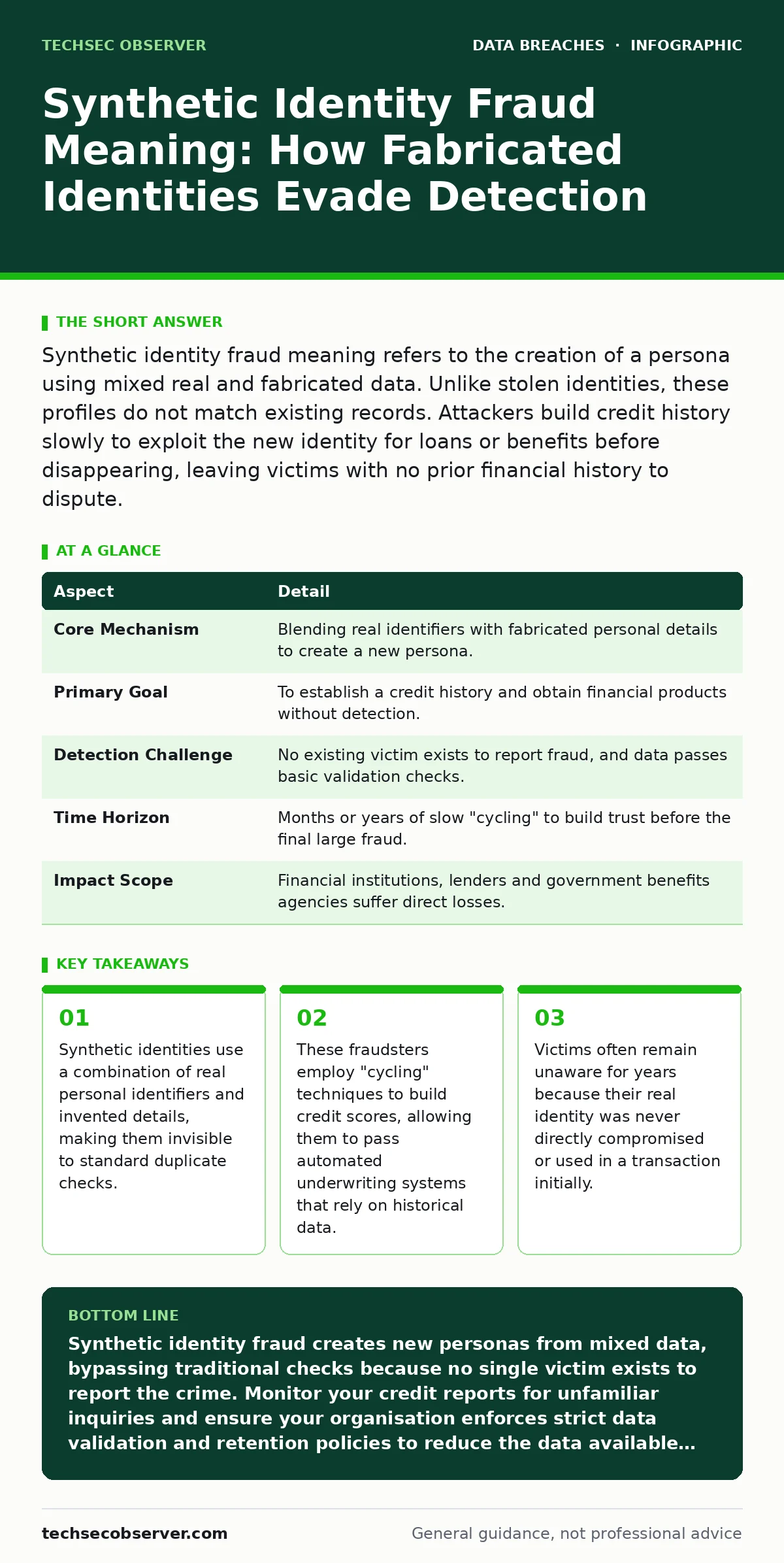
Synthetic identity fraud meaning refers to the creation of a persona using mixed real and fabricated data. Unlike stolen identities, these profiles do not match existing records. Attackers build credit history slowly to exploit the new identity for loans or benefits before disappearing, leaving victims with no prior financial history to dispute.
The Paper Child Analogy
Imagine a child who never existed on paper. This person has a name, an address and a social security number that looks valid, but no birth certificate, no school records and no family history. They are a ghost. Synthetic identity fraud operates on this exact principle. The attacker constructs a person from scratch. They take a real piece of identification, such as a stolen social security number, and attach it to a fake name, a rented address and fabricated employment details. The result is a new entity that does not correspond to any living human being.
This entity can open bank accounts, apply for credit cards and request loans. Because the profile is new, it does not trigger alarms designed to catch known criminals. The system sees a fresh applicant with no prior negative history. The attacker nurtures this profile carefully. They make small purchases and pay them off promptly. This behaviour builds a credit score. Once the score reaches a usable level, the attacker maxes out the available credit or withdraws large sums. Then the identity vanishes. The financial institution is left with a debt owed by a person who never existed.
| Aspect | Detail |
|---|---|
| Core Mechanism | Blending real identifiers with fabricated personal details to create a new persona. |
| Primary Goal | To establish a credit history and obtain financial products without detection. |
| Detection Challenge | No existing victim exists to report fraud, and data passes basic validation checks. |
| Time Horizon | Months or years of slow "cycling" to build trust before the final large fraud. |
| Impact Scope | Financial institutions, lenders and government benefits agencies suffer direct losses. |
Synthetic Identity Fraud Meaning
Synthetic identity fraud meaning is the creation of a fraudulent persona by combining real and fake information. This differs fundamentally from traditional identity theft. In identity theft, a criminal assumes the identity of a specific, existing person. That person will eventually notice unauthorized transactions and dispute them. In synthetic fraud, there is no single victim to notice the crime initially. The real data component, often a social security number, belongs to someone else, but that person is not the one applying for credit. The synthetic identity is a new entity. It has no prior credit file. It has no history of late payments. It looks clean to automated screening tools. The fraudster exploits the gap between identity verification and identity validation.
Verification checks if the data format is correct. Validation checks if the data belongs to a real, active person with a consistent history. Many systems perform the former but lack the depth for the latter. This allows the synthetic identity to slip through. The fraudster then uses this clean slate to their advantage. They apply for small credit lines. They pay them in full. They repeat this process to raise their credit score. This phase is known as cycling. It can take months. It requires patience and capital. The goal is to create a trustworthy profile. Once the profile is strong, the fraudster executes the "bust out". They apply for large loans or high-limit cards. They extract the maximum value. They abandon the identity immediately. The lender is left with a non-existent borrower.
How the Construction Works
The construction of a synthetic identity relies on data aggregation. Attackers source real identifiers from various breaches or leaks. They need a valid government-issued identifier to pass the initial checks. This is often a social security number or a national ID number. They then generate or purchase fake names, addresses and phone numbers. These components must be consistent. The address must match the phone number’s area code. The name must match the gender associated with the identifier if the system checks for this. Advanced attackers use machine learning to ensure these details align with demographic patterns. They avoid obvious mismatches that would trigger manual review. The next step is identity establishment. The attacker opens a bank account or a mobile phone contract. These require identity proof.
They use forged documents or manipulated digital images. With a phone line and a bank account, the identity gains legitimacy. Banks and carriers verify the person exists. The attacker then begins the credit building phase. They apply for low-risk credit products. Store credit cards are common targets. They are easier to approve and have lower limits. The attacker uses these cards for small, everyday purchases. They pay the bills on time. This creates a trail of positive behaviour. Credit reporting agencies update the file. The credit score rises. The identity becomes financially viable. The attacker monitors the score. They wait for it to reach a threshold that qualifies for larger loans. This patience is the key to success. Rushing the process triggers fraud detection algorithms. Slow, steady growth mimics genuine consumer behaviour.
Who It Affects and the Hidden Victims
Financial institutions bear the direct cost of synthetic identity fraud. They issue loans to non-existent borrowers. They absorb the loss when the fraudsters disappear. Insurance companies also suffer. Synthetic identities are used to file false claims. The attacker creates a persona, buys an insurance policy, and then stages a loss. The claim is processed because the policyholder appears legitimate. Government agencies are affected too. Synthetic identities can be used to claim unemployment benefits or tax refunds. This drains public funds. But there is a hidden cost to individuals. The person whose real identifier was used may never know. Their credit file remains clean. They do not see unauthorized charges. They do not receive collection notices. However, the association of their identifier with a fraudulent entity can cause problems later.
If the synthetic identity defaults on a loan, the bad debt may be linked to the real identifier in some databases. This can lower the real person’s credit score. It can trigger flags for future loan applications. The victim must spend time and effort to clear their name. They must prove that they did not apply for the credit. This is difficult because the application data looks plausible. It matches the format of real applications. It includes a real identifier. The victim must demonstrate that the other details are fake. This requires detailed investigation. It often involves contacting multiple institutions. The process is slow and frustrating. The victim has been harmed, but not in the traditional way. Their identity was not stolen. It was borrowed. This distinction makes it harder to seek recourse.
What People Usually Get Wrong
Many people believe that monitoring their own credit report will detect synthetic identity fraud. This is incorrect. Since the synthetic identity uses a different name and address, it will not appear on the victim’s credit report. The victim sees no activity. The fraud operates under a different alias. Another common mistake is assuming that two-factor authentication prevents this fraud. Two-factor authentication protects existing accounts. It does not prevent the creation of new accounts. The attacker is creating a new identity, not accessing an old one. They set up their own two-factor authentication for the synthetic persona. They control the phone number and the email address associated with it. The security measure is bypassed because the attacker is the legitimate user of the new account.
Some also think that freezing their credit stops synthetic fraud. Credit freezes prevent new inquiries on your existing file. They do not stop an attacker from creating a new file under a different name using your identifier. The attacker does not pull your credit. They create a new credit file. The freeze is irrelevant to the new identity. This misunderstanding leads to false confidence. People believe they are protected when they are not. They focus on protecting their existing history. They ignore the risk of their data being used to build a new one. This gap in understanding allows synthetic fraud to thrive. The fraudsters rely on this confusion. They know that most monitoring tools look for changes to existing profiles. They do not look for the creation of new ones.
See also: Data Loss Prevention Rules: How to Stop Leaks Without Blocking Work
What To Do About It
Preventing synthetic identity fraud requires systemic changes, not just individual vigilance. Individuals can limit the damage by securing their personal data. Use strong, unique passwords for all accounts. Enable multi-factor authentication where possible. This protects your existing accounts from being used to gather more data. Monitor your bank and credit card statements for unusual activity. Report any discrepancies immediately. While this does not stop synthetic fraud, it limits the data available to attackers. Be cautious about sharing personal information online. Scammers use social media to gather details for constructing identities. Limit the amount of personal data you post. Check your credit reports regularly. Look for any accounts you did not open. Even if the name is different, the identifier might be the same.
Dispute any unfamiliar entries. This helps keep your own file clean. Financial institutions must improve their verification methods. They should use behavioural analytics. This involves tracking how a user interacts with their systems. A synthetic identity may behave differently than a real person. They may apply for credit at unusual times. They may use devices that do not match their profile. Machine learning models can detect these anomalies. Institutions should also cross-reference data sources. They should check if the address matches the phone number. They should verify employment details independently. Relying on self-reported data is risky. Implementing stricter know-your-customer rules can help. These rules require more robust proof of identity. They may slow down the onboarding process, but they reduce fraud.
The Role of Data Governance
Effective data governance is a defence against synthetic identity fraud. Organisations must understand where their data comes from and how it is used. Poor data retention policies can leave old records exposed. Attackers harvest data from old databases. They use this data to construct identities. Implementing strict data loss prevention measures can stop this leakage. These measures monitor data flows and block unauthorized transfers. Digital forensics can help identify how data was breached. Understanding the breach vector allows organisations to patch vulnerabilities. Insider data theft is also a risk. Employees may sell data to attackers. Strict access controls and monitoring can mitigate this. Customer data exposure must be minimised. Only share what is necessary.
Encrypt data at rest and in transit. This makes stolen data harder to use. A robust data breach response plans ensures that breaches are contained quickly. Slow response times allow attackers to exfiltrate more data. This data fuels synthetic identity creation. Reducing the amount of available data reduces the fuel for fraud. Organisations must also consider tax identity theft risks. This is a related form of fraud. Preventing it requires similar controls. The 3-2-1 backup rule helps protect data integrity. It ensures that data is not lost or corrupted. While not directly preventing fraud, it ensures that records are accurate. Accurate records help in detecting anomalies. Inconsistent data may indicate fraud. Clean data supports better analytics. Better analytics detect fraud faster.
Key takeaways
- Synthetic identities use a combination of real personal identifiers and invented details, making them invisible to standard duplicate checks.
- These fraudsters employ "cycling" techniques to build credit scores, allowing them to pass automated underwriting systems that rely on historical data.
- Victims often remain unaware for years because their real identity was never directly compromised or used in a transaction initially.
Synthetic identity fraud creates new personas from mixed data, bypassing traditional checks because no single victim exists to report the crime. Monitor your credit reports for unfamiliar inquiries and ensure your organisation enforces strict data validation and retention policies to reduce the data available for fraudsters.
Frequently asked questions
Can a credit freeze stop synthetic identity fraud?
No, a credit freeze only protects your existing credit file from new inquiries. It does not prevent criminals from creating a new credit file under a different name using your stolen identifier.
How do I know if my data was used for a synthetic identity?
You may not know until the synthetic identity defaults on a loan and the debt is linked to your identifier, or if you see unfamiliar accounts on your credit report during a routine check.
Is synthetic identity fraud the same as identity theft?
No, identity theft involves taking over an existing person's identity, while synthetic fraud creates a new, fake identity by blending real and fake data, leaving no single direct victim initially.
What should banks do to prevent this?
Banks should implement advanced behavioural analytics, cross-reference multiple data sources for consistency, and enforce stricter identity verification protocols that go beyond simple document checks.
How this guide was produced: written by the TechSec Observer editorial team with AI assistance, checked against the public references listed below, and reviewed when the facts change. See our editorial policy or report an error.