Difference Between DevSecOps and SecDevOps: The Structural Reality
The naming difference masks a deeper architectural shift from security as a gatekeeper to security as an automated, embedded control plane within the deployment pipeline.

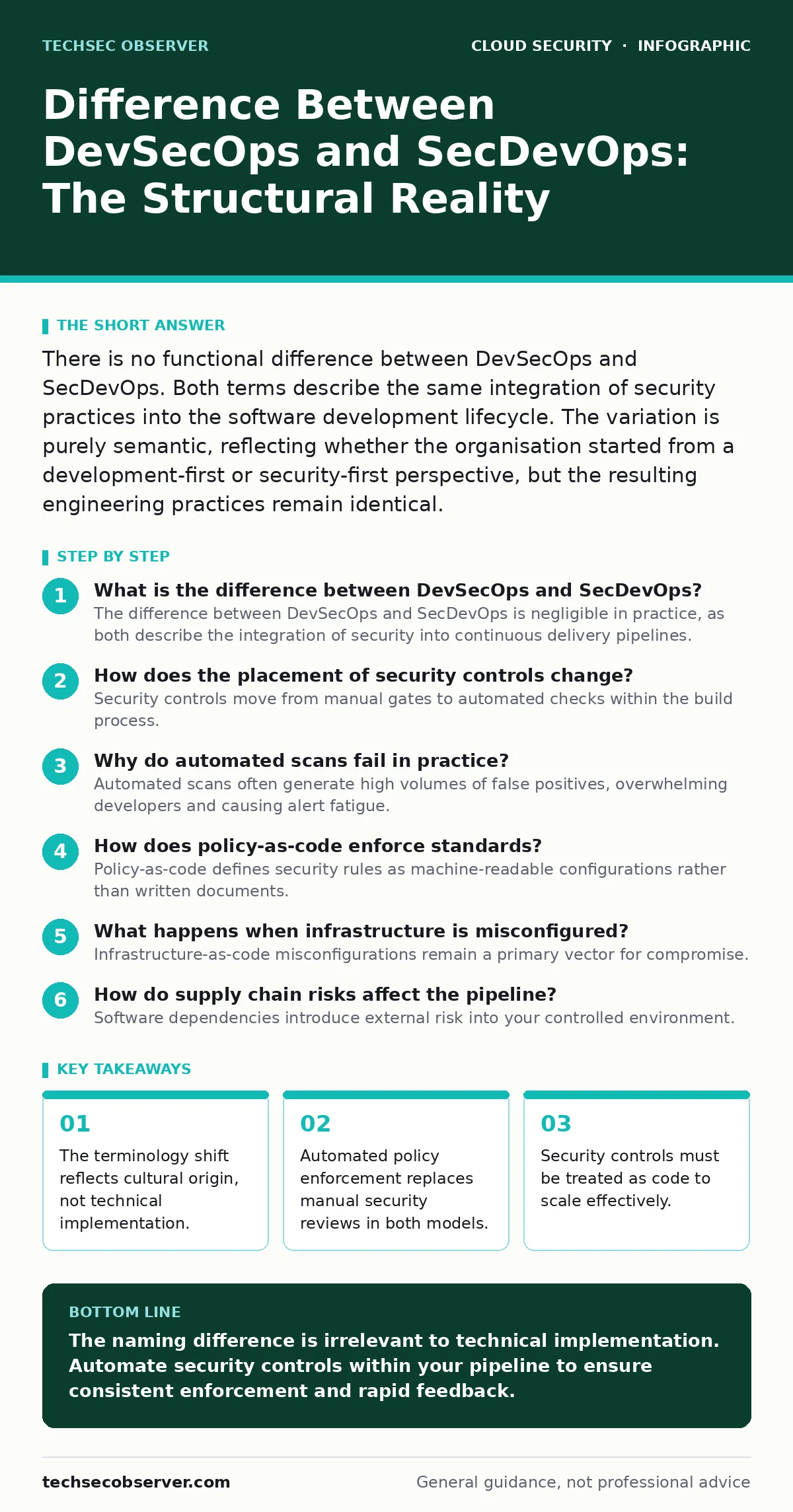
There is no functional difference between DevSecOps and SecDevOps. Both terms describe the same integration of security practices into the software development lifecycle. The variation is purely semantic, reflecting whether the organisation started from a development-first or security-first perspective, but the resulting engineering practices remain identical.
What is the difference between DevSecOps and SecDevOps?
The difference between DevSecOps and SecDevOps is negligible in practice, as both describe the integration of security into continuous delivery pipelines. DevSecOps places security between development and operations, implying a sequential step. SecDevOps places security at the start, implying earlier involvement. Both models require the same technical controls: automated scanning, policy-as-code, and immutable infrastructure. The choice of term usually reflects organisational heritage rather than a distinct methodology.
How does the placement of security controls change?
Security controls move from manual gates to automated checks within the build process. In traditional models, security reviews occur after development is complete, creating bottlenecks. In integrated models, controls run automatically during code commits and build stages. This shift reduces the cost of fixing vulnerabilities, as errors are caught before they reach production environments. The mechanism relies on pipeline integration, not human intervention.
| Model | Primary Focus | Control Timing | Cultural Driver |
|---|---|---|---|
| Traditional | Compliance | Post-development | Regulatory pressure |
| DevSecOps | Speed with Safety | During build | Developer efficiency |
| SecDevOps | Security by Design | Pre-commit | Risk mitigation |
Why do automated scans fail in practice?
Automated scans often generate high volumes of false positives, overwhelming developers and causing alert fatigue. When a tool flags every minor issue, teams ignore the results, rendering the control ineffective. The failure point is not the scanner, but the lack of triage logic. Tools must be tuned to suppress known safe patterns and prioritise critical findings. Without this tuning, security becomes noise rather than signal.
How does policy-as-code enforce standards?
Policy-as-code defines security rules as machine-readable configurations rather than written documents. This approach allows the pipeline to reject non-compliant builds automatically. For example, a rule can prevent the deployment of containers with root privileges. This eliminates human error and ensures consistent enforcement across all environments. The code itself becomes the source of truth for security posture.
What happens when infrastructure is misconfigured?
Infrastructure-as-code misconfigurations remain a primary vector for compromise. When developers define resources in code, they often copy-paste templates without understanding the security implications. This leads to exposed storage buckets or overly permissive network rules. Automated tools can detect these errors, but they require accurate baseline definitions. See our guide on infrastructure-as-code misconfigurations for deeper technical patterns.
See also: Cloud Compliance Standards: Mapping Rules to Infrastructure Code · Cryptojacking: How to Detect and Stop Silent Resource Theft
How do supply chain risks affect the pipeline?
Software dependencies introduce external risk into your controlled environment. Third-party libraries may contain vulnerabilities or malicious code that bypasses internal checks. Verifying the integrity of these components requires scanning dependencies and validating signatures. This extends security beyond your own code to the entire build graph. Refer to cloud supply chain risks for strategies on verifying external inputs.
Why is service account security critical?
Service accounts often hold excessive permissions to facilitate automated processes. These accounts are targeted because they provide persistent access without user interaction. Compromising a service account can lead to full environment takeover. Principles of least privilege must apply to these accounts, with credentials rotated automatically. See service account security for methods to restrict automated access.
How do you measure success in this model?
Success is measured by the speed of feedback, not the number of vulnerabilities found. A fast-acting pipeline that blocks critical issues within minutes is more valuable than a slow, comprehensive scan. Metrics should focus on mean time to detection and mean time to remediation. This ensures security supports velocity rather than hindering it. Avoid vanity metrics that do not correlate with actual risk reduction.
What is the role of identity in automation?
Identity management becomes complex when machines interact with other machines. Service-to-service authentication requires robust credential handling. Weak identity controls allow attackers to pivot between components. Implement mutual TLS or short-lived tokens to verify machine identities. This prevents unauthorised access even if network boundaries are breached. See MFA for cloud accounts for human-centric identity controls.
How do you handle legacy systems?
Legacy systems often lack the automation required for integrated security. They may rely on manual processes or unsupported technologies. Forcing them into a modern pipeline can introduce instability. A hybrid approach isolates these systems while applying perimeter controls. Gradual refactoring allows incremental adoption of automated security. Refer to orphaned cloud resources for managing decommissioned or isolated assets.
What about SaaS applications in the workflow?
SaaS applications used by development teams introduce their own security posture challenges. These applications often integrate with core systems, expanding the attack surface. Misconfigured permissions or weak authentication in these tools can expose sensitive data. Regular auditing of SaaS configurations is necessary. See SaaS security posture management for continuous monitoring strategies.
How do you prevent account hijacking?
Cloud account hijacking often results from compromised credentials or weak access controls. Attackers exploit these weaknesses to gain persistent access. Multi-factor authentication and conditional access policies mitigate this risk. Monitoring for unusual activity patterns helps detect breaches early. See cloud account hijacking for detailed defence strategies against credential theft.
What is the final takeaway?
The distinction between DevSecOps and SecDevOps is academic. The engineering reality is the automation of security controls within the development lifecycle. Focus on building reliable, fast-acting checks rather than debating terminology. This approach ensures security scales with development velocity.
Key takeaways
- The terminology shift reflects cultural origin, not technical implementation.
- Automated policy enforcement replaces manual security reviews in both models.
- Security controls must be treated as code to scale effectively.
The naming difference is irrelevant to technical implementation. Automate security controls within your pipeline to ensure consistent enforcement and rapid feedback.
Frequently asked questions
Which term is more popular in industry reports?
DevSecOps is more commonly used, but both terms appear frequently. The popularity does not indicate a difference in practice.
Can I implement this without changing my tools?
You can begin by adding automated scans to your existing pipeline. Full integration requires adopting policy-as-code and secret management.
Does this replace the need for security teams?
No. Security teams shift from manual review to building and maintaining the automation platform. Their role becomes more technical and strategic.
How long does adoption take?
Adoption varies by organisation size and legacy complexity. Initial automation can be implemented in weeks, but cultural shift takes longer.
How this guide was produced: written by the TechSec Observer editorial team with AI assistance, checked against the public references listed below, and reviewed when the facts change. See our editorial policy or report an error.