MFA for Cloud Accounts: Benefits, Limitations and Trade-offs
Multi-factor authentication stops stolen credentials but fails to protect service accounts and automated pipelines from token abuse.

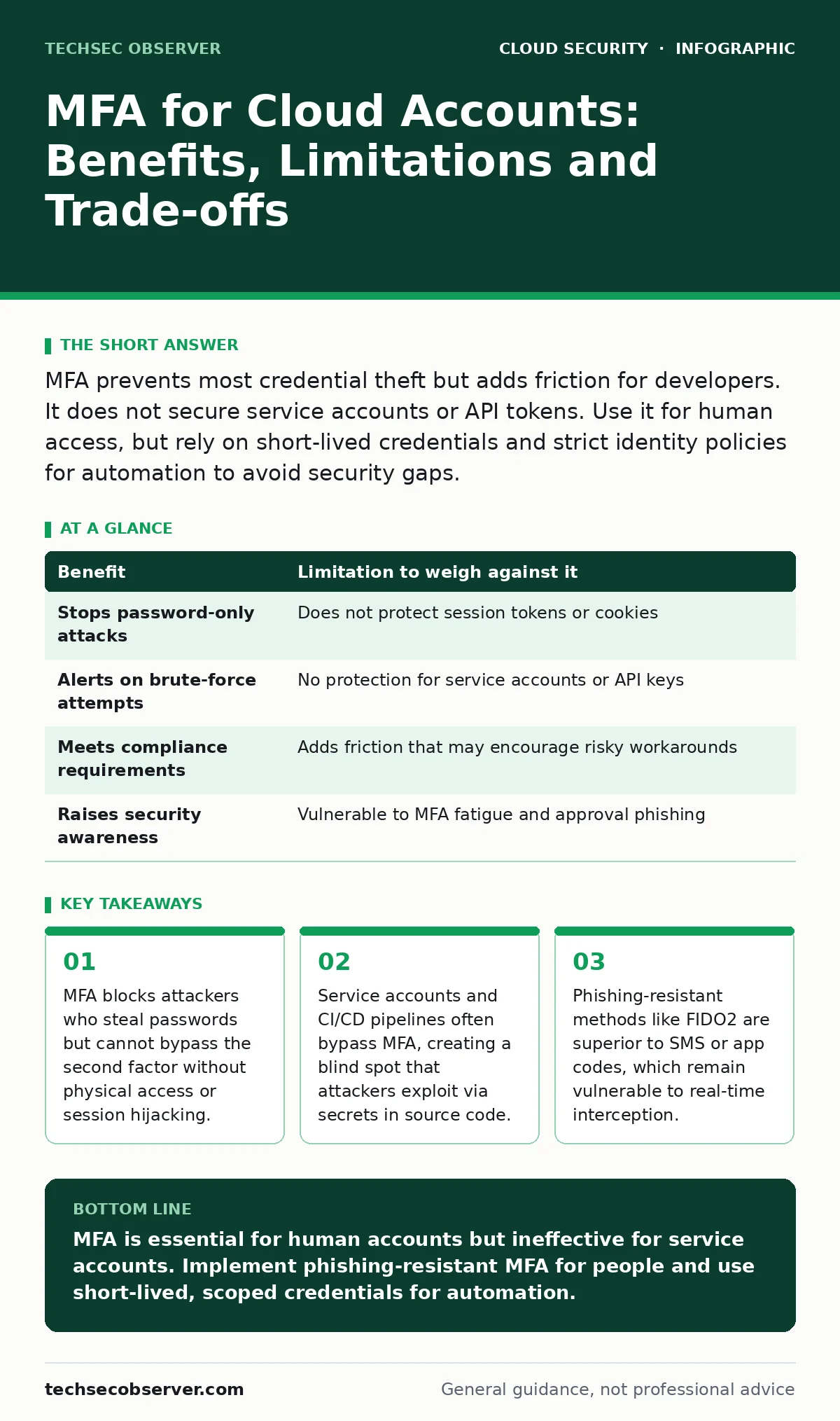
MFA prevents most credential theft but adds friction for developers. It does not secure service accounts or API tokens. Use it for human access, but rely on short-lived credentials and strict identity policies for automation to avoid security gaps.
The Mechanics of Cloud Identity Protection
Multi-factor authentication requires two distinct proofs of identity. The first is usually something you know, such as a password. The second is something you have, like a hardware token, or something you are, such as a biometric scan. In cloud environments, this layer is the primary defence against credential theft. Without it, a stolen password grants immediate access to your entire infrastructure. With it, the attacker must also compromise the second factor, which is significantly harder to achieve remotely.
However, MFA is not a silver bullet. It protects the login event, not the session or the underlying resources. Once authenticated, a user or process retains the permissions granted to that identity. If those permissions are too broad, the value of MFA diminishes because the blast radius of a compromised session remains large. You must treat MFA as a gatekeeper, not a shield for everything inside the gate.
Concrete Benefits of Enforcement
The primary benefit of MFA is the neutralisation of credential stuffing and password spraying attacks. These automated techniques try thousands of common passwords against login endpoints. If a password is correct but the second factor fails, the attack stops. This reduces the success rate of these common vectors to near zero for human-operated accounts. It also provides an immediate alert mechanism. Most cloud identity providers log failed MFA attempts, allowing your blue team operations to detect brute-force activity in real time.
Another benefit is compliance alignment. Many regulatory frameworks require MFA for administrative access. Implementing it satisfies this requirement while simultaneously improving security. It also encourages a culture of security awareness. When users encounter MFA prompts regularly, they become more attuned to authentication flows, making them more likely to notice phishing attempts that try to mimic login screens.
Honest Limitations and Blind Spots
MFA does not protect against session hijacking. If an attacker steals an active session cookie or token, they bypass the MFA checkpoint entirely. This is why token hygiene is critical. You must configure short session timeouts and monitor for anomalous session behaviour. MFA also does not protect service accounts. These non-human identities, used by applications and scripts, typically use API keys or certificates. They cannot perform MFA, creating a significant gap in your security posture.
Furthermore, MFA introduces friction. Developers and operations staff may seek ways to bypass it, leading to risky workarounds. For example, they might store long-lived API keys in plaintext to avoid repeated authentication. This directly conflicts with best practices for secrets in source code. The friction can also lead to MFA fatigue, where users approve legitimate login prompts without verifying the context, assuming the request is valid. This makes them vulnerable to approval-based phishing attacks.
| Benefit | Limitation to weigh against it |
|---|---|
| Stops password-only attacks | Does not protect session tokens or cookies |
| Alerts on brute-force attempts | No protection for service accounts or API keys |
| Meets compliance requirements | Adds friction that may encourage risky workarounds |
| Raises security awareness | Vulnerable to MFA fatigue and approval phishing |
When It Is Worth It
MFA is worth it for every human-operated account, especially those with administrative privileges. The cost of implementing it is low compared to the cost of a breach. For standard users, the friction is minimal, and the security gain is substantial. It is also worth it for privileged access workstations. These machines are used for managing critical infrastructure, and securing the identity on them is paramount. You should enforce strict MFA policies for any account that can modify security settings, manage users, or access sensitive data.
In environments where infrastructure-as-code misconfigurations are common, MFA adds a layer of defence in depth. Even if a script is misconfigured and exposes credentials, the attacker still needs the second factor to log in interactively. This buys time for detection and response. It is also worth it for remote access. If your team works from various locations, the risk of credential theft increases. MFA ensures that physical proximity to the second factor is required, adding a strong layer of verification.
When It Is Not Worth It
MFA is not worth it for service accounts that require automated, headless access. You cannot prompt a CI/CD pipeline for a fingerprint. For these identities, you must use alternative controls. Short-lived credentials, such as those generated by federated identities, are a better choice. These credentials expire quickly, reducing the window of opportunity for an attacker. You should also use strict role-based access control to limit what these accounts can do. Relying on MFA for automation is a technical impossibility and a security anti-pattern.
It is also not worth it if you lack a strong password policy. MFA complements strong passwords; it does not replace them. If users have weak passwords, they are more likely to fall for phishing attacks that steal both the password and the second factor code. You must address password quality first. Additionally, if your organisation lacks monitoring capabilities, MFA alerts may go unnoticed. Without the ability to detect and respond to failed MFA attempts, you lose one of its key benefits.
See also: Difference Between DevSecOps and SecDevOps: The Structural Reality · Cloud Compliance Standards: Mapping Rules to Infrastructure Code
The Developer Experience Trade-off
Developers often resist MFA due to the added steps in their workflow. This friction can lead to decreased productivity and frustration. However, the trade-off is necessary. The convenience of single-factor authentication is outweighed by the risk of account hijacking. You can mitigate this friction by using seamless MFA methods. Platform authenticators, which use biometrics or device PINs, are nearly as fast as typing a password. Hardware tokens with USB or NFC support also minimise disruption.
Another strategy is to use conditional access policies. These policies require MFA only under certain conditions, such as when logging in from a new device or location. This reduces the number of times users are prompted while maintaining security. You can also integrate MFA into your development tools. Many IDEs and CLI tools support credential managers that handle authentication seamlessly. This keeps the security burden off the developer while maintaining strong identity verification.
Beyond MFA: A Holistic Approach
MFA is just one part of a broader security strategy. You must also address other risks, such as OAuth token abuse and cloud supply chain risks. These threats often bypass MFA entirely. For example, an attacker might exploit a misconfigured OAuth application to gain access without ever touching the login screen. You must audit your third-party integrations and restrict their permissions. Similarly, you must secure your software supply chain to prevent attackers from injecting malicious code that steals credentials.
Regularly review your identity permissions. Remove access that is no longer needed. Monitor for unusual activity, such as logins from unexpected locations or times. Combine MFA with other controls, such as encryption and network segmentation, to create a defence in depth. No single control is sufficient. MFA is a powerful tool, but it must be part of a comprehensive security programme.
Key takeaways
- MFA blocks attackers who steal passwords but cannot bypass the second factor without physical access or session hijacking.
- Service accounts and CI/CD pipelines often bypass MFA, creating a blind spot that attackers exploit via secrets in source code.
- Phishing-resistant methods like FIDO2 are superior to SMS or app codes, which remain vulnerable to real-time interception.
MFA is essential for human accounts but ineffective for service accounts. Implement phishing-resistant MFA for people and use short-lived, scoped credentials for automation.
Frequently asked questions
Does MFA protect against phishing?
Standard MFA methods like SMS or app codes can be phished. Phishing-resistant methods like FIDO2 hardware keys are much harder to bypass and provide stronger protection.
How do I secure service accounts without MFA?
Use short-lived credentials generated by federated identities. Limit their permissions using least privilege principles and monitor their activity for anomalies.
What is MFA fatigue?
MFA fatigue occurs when users are bombarded with approval requests and approve them without checking. Attackers use this to bypass MFA by sending multiple rapid requests.
Is SMS MFA safe?
SMS MFA is vulnerable to SIM swapping and interception. It is less secure than app-based or hardware-based methods and should be avoided for high-risk accounts.
How this guide was produced: written by the TechSec Observer editorial team with AI assistance, checked against the public references listed below, and reviewed when the facts change. See our editorial policy or report an error.