Infrastructure-as-Code Misconfigurations: The Hidden Risks in Your Templates
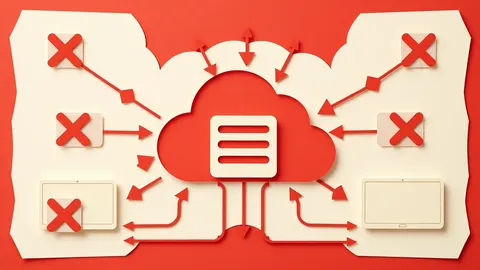
A single typo in a declarative configuration file can expose entire cloud environments, turning automated deployment into a vector for persistent access.

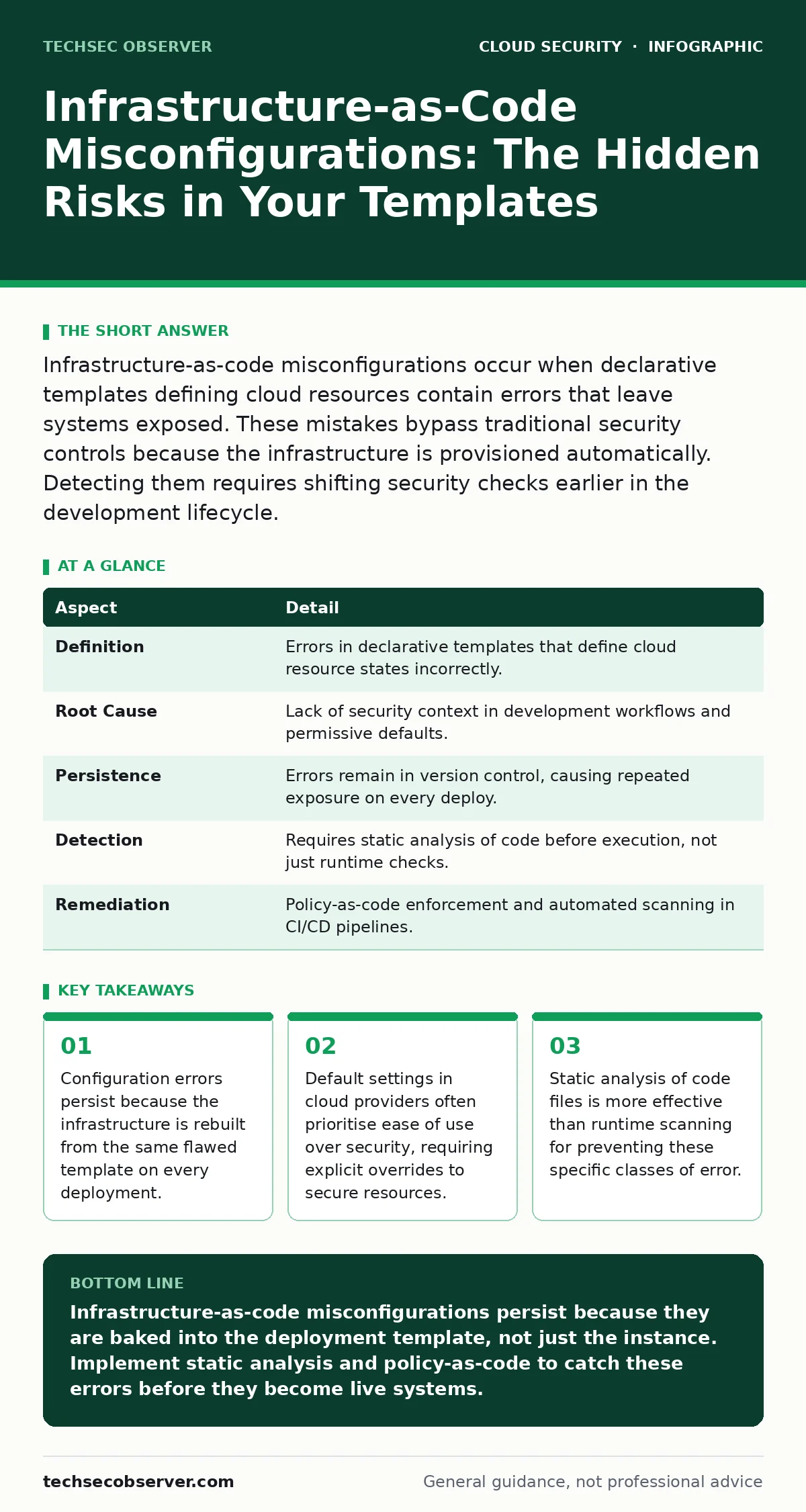
Infrastructure-as-code misconfigurations occur when declarative templates defining cloud resources contain errors that leave systems exposed. These mistakes bypass traditional security controls because the infrastructure is provisioned automatically. Detecting them requires shifting security checks earlier in the development lifecycle.
The Blueprint Analogy
Imagine you are handing a set of architectural plans to a construction crew. If the plans specify that the front door has no lock, the crew will build exactly that. They are not being negligent; they are following instructions. Infrastructure-as-code works the same way. You write a file that describes the desired state of your cloud environment, and the platform creates resources to match. If the description lacks security constraints, the resulting environment will lack them too.
This shift from manual clicking to code-based provisioning changes the nature of security errors. In a manual process, a human might forget to toggle a setting. In code, the omission is deliberate, repeatable, and version-controlled. The error becomes part of the permanent record of your system.
At a Glance
| Aspect | Detail |
|---|---|
| Definition | Errors in declarative templates that define cloud resource states incorrectly. |
| Root Cause | Lack of security context in development workflows and permissive defaults. |
| Persistence | Errors remain in version control, causing repeated exposure on every deploy. |
| Detection | Requires static analysis of code before execution, not just runtime checks. |
| Remediation | Policy-as-code enforcement and automated scanning in CI/CD pipelines. |
How Misconfigurations Arise
The primary driver is the gap between development speed and security awareness. Developers focus on functionality. A storage bucket needs to hold data. A database needs to accept connections. The path of least resistance is to leave access controls open or to use default credentials. Cloud providers often design their services to be easy to start, which means many resources are accessible by default until you explicitly restrict them.
Another factor is the abstraction layer. Tools that wrap cloud APIs in higher-level syntax can hide the underlying security implications. A developer might use a shorthand command that appears safe but translates into a broad permission set in the background. You may not see the risk in your code because the tool obscures the final configuration sent to the provider.
Common Forms of Error
Not all misconfigurations are equal. Some expose data directly, while others create paths for lateral movement. The most frequent issues involve access control and network visibility.
- Open storage containers: Cloud object storage is often used for backups or static assets. If the permission policy is set to public read, anyone on the internet can download the contents. This is not a hack; it is an open door.
- Overly broad permissions: Identity and access management policies define who can do what. Assigning "admin" rights to a service account that only needs to read logs violates the principle of least privilege. If that account is compromised, the attacker gains full control.
- Unencrypted data at rest: Databases and disk volumes should encrypt data by default. If a template does not enable encryption, the data sits in plaintext on physical hardware. If that hardware is stolen or accessed improperly, the data is readable.
- Public-facing management ports: Administrative interfaces like SSH or RDP should never face the public internet. Leaving these ports open invites brute-force attacks and exploits.
These errors are not rare. They are the result of standard workflows that do not include security validation. For deeper context on how credentials are handled, you might review our guide on secrets in source code, as hard-coded keys in templates are a frequent companion to these structural errors.
The Hidden Cost of Automation
The conventional wisdom is that automation reduces risk by removing human error. This is true for typos in passwords or missed clicks. It is false for logic errors. When you automate a mistake, you scale it.
Consider the lifecycle of a misconfiguration. In a manual world, a security audit might catch an open port on one server. The admin closes it. In an infrastructure-as-code world, the template is fixed. But what about the servers already running? They remain open until you explicitly trigger a re-provisioning. Worse, if you roll back to a previous version of the code, the vulnerability returns. The history of your infrastructure contains the history of your vulnerabilities.
This creates a unique challenge for compliance. Auditors cannot just look at the current state. They must examine the code repository to understand what could be deployed. This expands the attack surface to include your source control systems. See cloud supply chain risks for more on how compromised repositories can inject malicious configurations.
See also: Difference Between DevSecOps and SecDevOps: The Structural Reality · Cloud Compliance Standards: Mapping Rules to Infrastructure Code
What People Usually Get Wrong
Many teams believe that scanning the running cloud environment is sufficient. They use tools to check live resources for compliance. This is reactive. It tells you that a mistake exists, but it does not prevent the mistake from being made. By the time you detect the error, the resource has already been exposed.
Another common misconception is that security teams should write the infrastructure code. This creates a bottleneck. Developers need to iterate quickly. Instead, security teams should provide the guardrails. They define the allowed parameters and the forbidden states. The developers write the code within those boundaries.
Reducing the Risk
The solution lies in shifting left. This means checking the code before it creates anything. You need static analysis tools that understand the syntax of your infrastructure templates. These tools can flag open ports, missing encryption, or broad permissions before the code is merged into your main branch.
Implement policy-as-code. This allows you to define rules that are enforced automatically. For example, a rule might state that no storage bucket can be public. If a developer tries to commit such a template, the build fails. This provides immediate feedback. It turns security into a development constraint rather than an afterthought.
Regularly review your service accounts. Over time, permissions accumulate. A account that needed write access for a specific task might still have it months later. Pruning these permissions reduces the impact of any potential breach. For strategies on managing these identities, consult service account security.
Integrating with Broader Security
Infrastructure misconfigurations do not exist in a vacuum. They often interact with other vulnerabilities. An open database port is useless if the database requires strong authentication. However, if that authentication relies on weak tokens, the combination is dangerous.
Ensure your identity management is tight. Even if a port is open, strong authentication can stop an attacker. This is why MFA for cloud accounts is a critical layer of defence. It adds friction to the attack path. Additionally, consider SaaS security posture management if your infrastructure connects to third-party applications, as misconfigurations there can also lead to data leakage.
Key takeaways
- Configuration errors persist because the infrastructure is rebuilt from the same flawed template on every deployment.
- Default settings in cloud providers often prioritise ease of use over security, requiring explicit overrides to secure resources.
- Static analysis of code files is more effective than runtime scanning for preventing these specific classes of error.
Infrastructure-as-code misconfigurations persist because they are baked into the deployment template, not just the instance. Implement static analysis and policy-as-code to catch these errors before they become live systems.
Frequently asked questions
Can I fix misconfigurations without redeploying the infrastructure?
You can patch individual resources manually, but the underlying template remains flawed. You must update the code to prevent the error from recurring on the next deployment.
Do all cloud providers have the same risks?
The specific syntax differs, but the risks are universal. Any provider that allows declarative configuration faces the same potential for access control and encryption errors.
Is static analysis enough to secure my infrastructure?
No. Static analysis catches code errors. You still need runtime monitoring to detect drift, where the live state diverges from the intended code due to manual changes or attacks.
How do I handle legacy infrastructure not in code?
You must manually audit these resources. Plan to migrate them to infrastructure-as-code to gain visibility and control. Until then, they remain a blind spot in your security posture.
How this guide was produced: written by the TechSec Observer editorial team with AI assistance, checked against the public references listed below, and reviewed when the facts change. See our editorial policy or report an error.