The OSI Model 7 Layers: How Network Protocols Stack
The seven-layer framework isolates hardware failures from application logic, allowing developers to debug connectivity without rewriting core code.

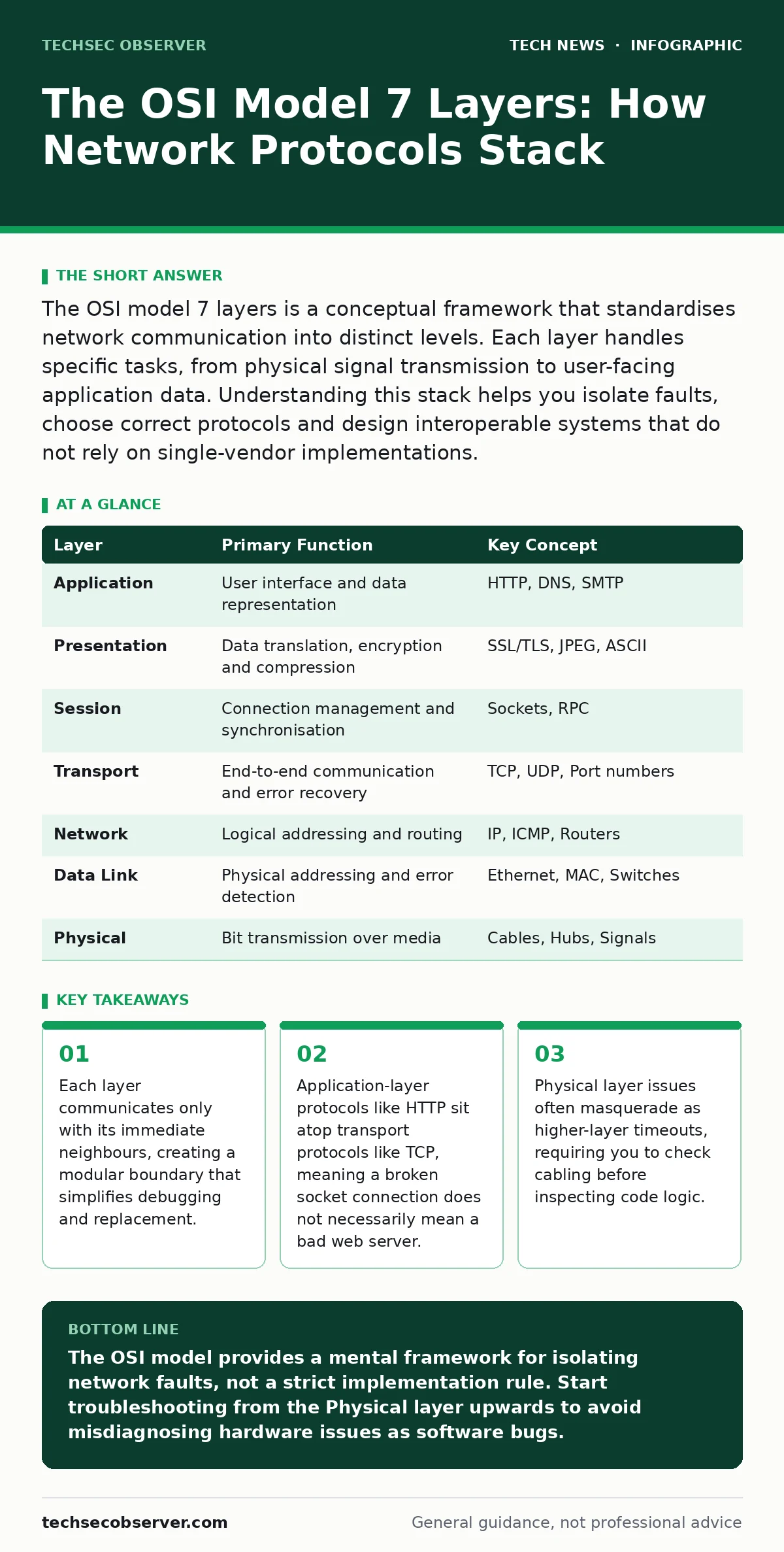
The OSI model 7 layers is a conceptual framework that standardises network communication into distinct levels. Each layer handles specific tasks, from physical signal transmission to user-facing application data. Understanding this stack helps you isolate faults, choose correct protocols and design interoperable systems that do not rely on single-vendor implementations.
The Anatomy of Network Communication
Imagine a postal system where every office handles only one specific task. One office accepts the letter, another stamps it, another loads it onto a truck, and another drives the truck. If the truck breaks down, the stamping office does not care. It simply waits for a new truck. The OSI model 7 layers operates on this same principle of strict separation. It divides network communication into seven distinct stages. Each stage has a specific job and interacts only with the stage above and below it. This modularity prevents a failure in one area from collapsing the entire system.
You encounter this structure every time your device connects to the internet. The model defines how data moves from your application down through the hardware and back up on the receiving end. It is not a physical protocol but a map of responsibilities. Developers use this map to understand where a problem originates. If an API call fails, you must know whether the failure happened during data formatting, routing or physical signal loss.
How the OSI Model 7 Layers Work
The stack processes data top-down on the sender and bottom-up on the receiver. The Application layer sits at the top. It interacts directly with software, translating user requests into a format the network understands. Below this, the Presentation layer handles data translation, encryption and compression. It ensures that the data looks the same to the receiving application, regardless of the underlying system architecture.
The Session layer manages dialogues between applications. It establishes, maintains and terminates connections. The Transport layer follows, ensuring reliable data transfer. It breaks data into segments, checks for errors and retransmits lost pieces. This is where protocols like TCP operate. Below transport lies the Network layer, which handles logical addressing and routing. It determines the best path for data to travel across interconnected networks.
The Data Link layer frames the data for transmission over a physical link. It handles local network addressing, often using MAC addresses. Finally, the Physical layer deals with the raw bit stream. It converts digital signals into electrical, optical or radio waves for transmission over cables or air. Each layer adds a header, or metadata, to the data. This process, called encapsulation, allows lower layers to handle the data without understanding its content.
| Layer | Primary Function | Key Concept |
|---|---|---|
| Application | User interface and data representation | HTTP, DNS, SMTP |
| Presentation | Data translation, encryption and compression | SSL/TLS, JPEG, ASCII |
| Session | Connection management and synchronisation | Sockets, RPC |
| Transport | End-to-end communication and error recovery | TCP, UDP, Port numbers |
| Network | Logical addressing and routing | IP, ICMP, Routers |
| Data Link | Physical addressing and error detection | Ethernet, MAC, Switches |
| Physical | Bit transmission over media | Cables, Hubs, Signals |
Where Abstraction Breaks Down
The clean separation of layers is an idealisation. In practice, boundaries blur. Modern networks often combine functions for efficiency. TLS, for instance, operates between the Presentation and Transport layers. It encrypts data at the presentation level but relies on transport-level reliability. When you configure public key cryptography for secure connections, you are effectively modifying the presentation layer's behaviour to protect session data.
Consider how VLANs operate. Virtual Local Area Networks create logical segments within a single physical network. This happens at the Data Link layer. However, the configuration affects routing decisions at the Network layer. If you misconfigure a VLAN tag, packets may drop silently. The application sees a timeout, but the root cause is a Layer 2 framing issue. This illustrates why understanding the full stack matters. A fix at the wrong layer wastes time and resources.
Common Misconceptions About the Stack
Many engineers assume the OSI model is a rigid specification. It is not. It is a reference model. Real-world protocols do not map perfectly to it. TCP/IP, the dominant internet suite, has only four layers. Developers often conflate the OSI layers with the TCP/IP layers. This causes confusion when troubleshooting. For instance, HTTP is an Application layer protocol, but it runs on TCP, a Transport layer protocol. You cannot run HTTP directly on IP.
Another mistake is assuming that higher layers know nothing of lower layers. While they should not depend on implementation details, they must respect constraints. An application sending massive data blobs may overwhelm the Transport layer's buffering capacity. This leads to congestion. You must design applications that respect the limits of the underlying network. Ignoring these limits creates bottlenecks that manifest as latency or dropped connections.
Practical Implications for Developers
When you write software that communicates over a network, you interact primarily with the Application and Transport layers. Frameworks handle the lower layers. However, you must understand the implications of each layer. If you use UDP instead of TCP, you sacrifice reliability for speed. This is a Transport layer choice with Application layer consequences. You must implement your own error handling and retransmission logic.
Security is another critical concern. Bluetooth security operates at multiple layers. Link-layer encryption protects the physical connection, while application-layer authentication verifies the user. If you rely solely on link-layer security, an attacker who compromises the device may still access the data. Layered defence requires security measures at each relevant level. Certificate management, for instance, ensures that the Presentation layer trusts the identity of the remote party.
See also: Why is WPA3 more secure and how it stops offline dictionary attacks
Future-Proofing Your Network Knowledge
The internet evolves, but the principles of layered communication remain. New protocols like QUIC combine features of TCP and TLS, operating between the Transport and Application layers. This blurs traditional boundaries further. However, the mental model of separation still applies. You must identify which responsibility belongs to which abstraction level.
As you integrate smart home security systems or complex enterprise APIs, you will encounter devices that speak different languages. The Presentation layer's role in translation becomes vital. Understanding how data formats and encodings work prevents interoperability issues. You can build systems that communicate seamlessly across diverse platforms. This requires a deep grasp of how each layer contributes to the final outcome.
Key takeaways
- Each layer communicates only with its immediate neighbours, creating a modular boundary that simplifies debugging and replacement.
- Application-layer protocols like HTTP sit atop transport protocols like TCP, meaning a broken socket connection does not necessarily mean a bad web server.
- Physical layer issues often masquerade as higher-layer timeouts, requiring you to check cabling before inspecting code logic.
The OSI model provides a mental framework for isolating network faults, not a strict implementation rule. Start troubleshooting from the Physical layer upwards to avoid misdiagnosing hardware issues as software bugs.
Frequently asked questions
Does the OSI model replace TCP/IP?
No, the OSI model is a theoretical framework, while TCP/IP is the actual protocol suite used on the internet. They coexist as conceptual tools and practical implementations.
Which layer does DNS operate on?
DNS operates primarily at the Application layer, though it uses both TCP and UDP at the Transport layer for different query types and zone transfers.
Can I skip layers in the OSI model?
No, data must pass through all layers to ensure proper formatting, addressing and transmission. However, some protocols combine functions of adjacent layers for efficiency.
How does this relate to digital certificates?
Digital certificates operate at the Presentation layer, providing identity verification and encryption keys that secure the data before it is segmented at the Transport layer.
How this guide was produced: written by the TechSec Observer editorial team with AI assistance, checked against the public references listed below, and reviewed when the facts change. See our editorial policy or report an error.